
Get informed about whiplash, its causes, its symptoms, and how to manage it to lead a more comfortable life.
Table of Contents
Introduction
An abrupt impact, whether from a vehicle accident, sports injury, or fall, may cause symptoms that start off as a small shock and progress to crippling pain and functional impairment. Whiplash is one such ailment that often lacks recognition due to its intricacy. Although it is often linked to rear-end crashes, whiplash is a complex injury that, if ignored, may have long-term consequences for the musculoskeletal system and cervical spine. Have you had shoulder and neck stiffness before? Do you have persistent, chronic headaches? Or does it seem like your neck’s range of motion is limited? We’ll talk about whiplash’s frequent origins, symptoms, effects on the cervical spine and musculoskeletal system, and evidence-based therapy options to lessen the pain-like symptoms in today’s post.
What Is Whiplash?
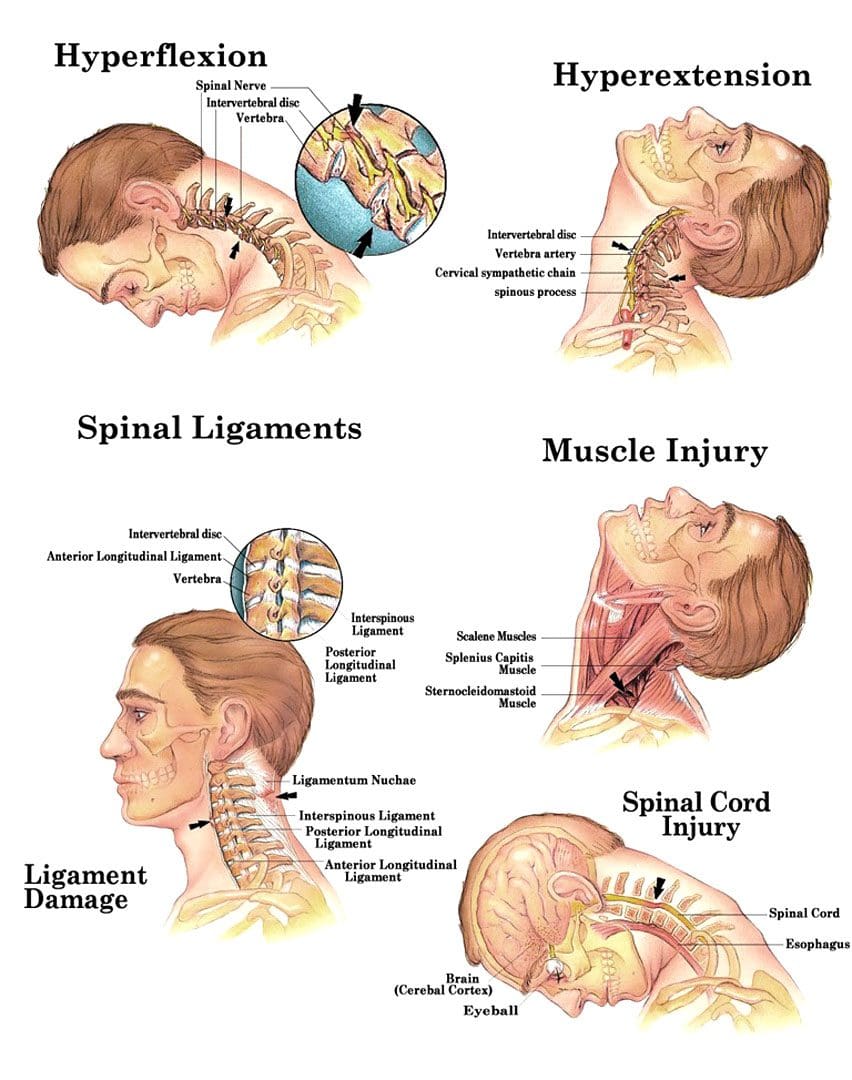
Whiplash is a type of neck injury associated with a rapid back-and-forth head-and-neck motion, mimicking the crack of a whip, hence the name. This causes persistent physical complaints and disability, and complaints when left untreated. (Mayou & Radanov, 1996) Medically, it is categorized under cervical acceleration-deceleration (CAD) injuries. This abrupt motion can damage muscles, ligaments, intervertebral discs, and even the neural structures of the cervical spine.
 Common Causes Of Whiplash
 Common Causes Of Whiplash
While motor vehicle accidents are the most recognized cause, many mechanisms can precipitate a whiplash injury:
- Rear-end car collisions
- Contact sports (e.g., football, hockey, wrestling)
- Physical assault or shaken trauma
- Slips, trips, and falls
- Roller coaster rides or sudden jolts
Even minor collisions at speeds as low as 5–10 mph can produce enough force to cause whiplash symptoms in vulnerable individuals.
Symptoms of Whiplash
When individuals are experiencing whiplash, the symptoms can appear immediately or may be delayed for 24–72 hours post-injury. Additionally, whiplash injuries are considered soft tissue injuries to the neck with various clinical symptoms that vary in severity and may include: (Chen et al., 2009)
- Neck pain and stiffness
- Reduced range of motion
- Shoulder and upper back pain
- Headaches, especially originating at the base of the skull
- Jaw pain or temporomandibular joint (TMJ) dysfunction
- Dizziness or visual disturbances
- Tingling or numbness sensations in the arms (cervical radiculopathy)
- Fatigue and cognitive issues (“whiplash-associated disorders” or WAD)
How Whiplash Affects the Cervical Spine and Musculoskeletal System
Whiplash is more than just a soft tissue injury, as it impacts several interconnected systems:
1. Cervical Spine
The rapid motion during a whiplash injury can lead to:
- Cervical facet joint irritation
- Intervertebral disc compression or herniation
- Muscle strain or ligamentous sprain
- Altered cervical lordosis, leading to chronic postural imbalances
This causes pain, stiffness, and tenderness in the neck area due to injuries within the bony, muscular, and ligamentous regions. (Alektoroff & Papanagiotou, 2021)
2. Musculoskeletal Dysfunction
Whiplash often initiates a cascade of biomechanical issues:
- Myofascial pain syndromes, especially in the trapezius, levator scapulae, and sternocleidomastoid muscles
- Compensatory thoracic or lumbar strain
- Poor proprioception and neuromuscular control
- Chronic trigger points and fibrotic tissue development
The longer these musculoskeletal imbalances persist, the more likely they will evolve into chronic pain syndromes and central sensitization.
Why Choose Chiropractic?-Video
Diagnosing Whiplash
Diagnosis is largely clinical, supported by a thorough history and physical exam. Imaging may be required to rule out more severe pathology:
- X-rays: To rule out fractures or malalignment
- MRI: For soft tissue or disc pathology
- CT scans: If fracture or serious trauma is suspected
- Functional assessments: Range of motion, palpation, neurologic evaluation
Evidence-Based Treatments for Whiplash
Treatment for whiplash should be multimodal and individualized, focusing on restoring function, reducing inflammation, and promoting healing. (Bussieres et al., 2016)
1. Chiropractic Care
Chiropractic adjustments can offer significant benefits in managing whiplash-associated disorders:
- Spinal manipulation therapy (SMT): Restores joint mobility, reduces cervical stiffness, and re-establishes biomechanical balance.
- Myofascial release and soft tissue mobilization: Target muscle tension, trigger points, and fascial restrictions.
- Postural retraining and ergonomic correction: Essential for long-term resolution.
Additionally, chiropractic patients experienced significant improvements in neck pain and function.
2. Physical Therapy
Individuals dealing with neck pain associated with whiplash can benefit from physical therapy to improve neck pain and disability. (Chrcanovic et al., 2022) Rehabilitative exercises are fundamental:
- Neck range-of-motion drills
- Isometric strengthening
- Scapular stabilization and postural correction
- Proprioceptive neuromuscular facilitation (PNF)
3. Functional Medicine Approach
From a functional medicine standpoint, addressing systemic inflammation, nutritional deficiencies, and stress response can enhance recovery:
- Anti-inflammatory nutrition (e.g., omega-3s, curcumin)
- Magnesium and B-complex supplementation for nerve healing
- Sleep optimization and cortisol balance
4. Other Complementary Treatments
- Acupuncture: Improves blood flow and pain modulation while alleviating pain and promoting relaxation. (Moon et al., 2014)
- Gua Sha or cupping therapy: Relieves muscular tension
- Dry needling: Effective for persistent trigger points
- Manual lymphatic drainage: For patients experiencing edema or prolonged inflammation
Recovery and Prognosis
With consistent and proper treatment, many individuals recover within a few weeks. However, approximately 30–50% of individuals may develop chronic symptoms if not properly managed early on. Factors predicting prolonged recovery include:
- High initial pain intensity
- Poor coping mechanisms
- History of prior neck injury
- Psychosocial stressors
Early intervention using a holistic, integrative care model offers the best outcomes in preventing chronic whiplash-associated disorders.
Final Thoughts
For both people and medical experts, whiplash is a complicated neuromusculoskeletal injury that requires more consideration than the usual “neck strain” classification. For an accurate diagnosis and successful management, it is crucial to comprehend the complex effects on the cervical spine, neurology, and musculoskeletal function. The individual’s quality of life may be improved and symptoms can be lessened by combining non-surgical treatments in a personalized treatment plan.
Injury Medical & Personal Injury Clinic
We associate certified medical providers who understand the importance of assessing individuals with whiplash associated with their necks. When asking important questions to our associated medical providers, we advise patients to incorporate customized treatment plans for their pain associated with whiplash. Dr. Alex Jimenez, D.C., uses this information as an academic service. Disclaimer
References
Alektoroff, K., & Papanagiotou, P. (2021). [Whiplash injury of the cervical spine]. Radiologe, 61(8), 710-713. doi.org/10.1007/s00117-021-00877-5 (Schleudertrauma der Halswirbelsaule.)
Bussieres, A. E., Stewart, G., Al-Zoubi, F., Decina, P., Descarreaux, M., Hayden, J., Hendrickson, B., Hincapie, C., Page, I., Passmore, S., Srbely, J., Stupar, M., Weisberg, J., & Ornelas, J. (2016). The Treatment of Neck Pain-Associated Disorders and Whiplash-Associated Disorders: A Clinical Practice Guideline. J Manipulative Physiol Ther, 39(8), 523-564 e527. doi.org/10.1016/j.jmpt.2016.08.007
Chen, H. B., Yang, K. H., & Wang, Z. G. (2009). Biomechanics of whiplash injury. Chin J Traumatol, 12(5), 305-314. www.ncbi.nlm.nih.gov/pubmed/19788851
www.sciencedirect.com/science/article/pii/S1008127509600651?via%3Dihub
Chrcanovic, B., Larsson, J., Malmstrom, E. M., Westergren, H., & Haggman-Henrikson, B. (2022). Exercise therapy for whiplash-associated disorders: a systematic review and meta-analysis. Scand J Pain, 22(2), 232-261. doi.org/10.1515/sjpain-2021-0064
Mayou, R., & Radanov, B. P. (1996). Whiplash neck injury. J Psychosom Res, 40(5), 461-474. doi.org/10.1016/0022-3999(95)00586-2
Moon, T. W., Posadzki, P., Choi, T. Y., Park, T. Y., Kim, H. J., Lee, M. S., & Ernst, E. (2014). Acupuncture for treating whiplash associated disorder: a systematic review of randomised clinical trials. Evid Based Complement Alternat Med, 2014, 870271. doi.org/10.1155/2014/870271
Disclaimer
What's your reaction?