Table of Contents
Stress Headaches vs. Migraines: How Sleep, Muscle Tension, and Daily Habits Affect Headache Patterns
Abstract
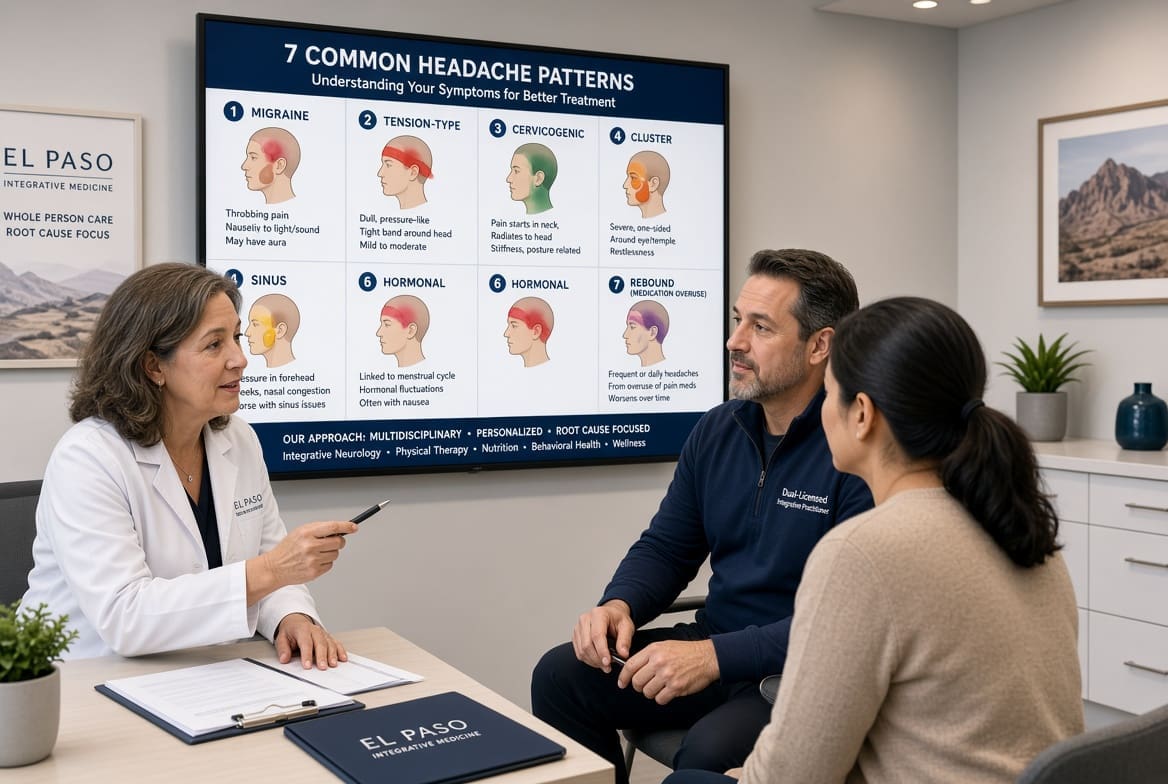
A headache after a stressful day may feel like a tight band around the head. Another headache may arrive with throbbing pain, nausea, light sensitivity, or the need to lie quietly in a dark room. Although people often call both experiences a “stress headache,” they may represent very different headache patterns.
Tension-type headaches and migraines can both be influenced by poor sleep, emotional stress, muscle tension, missed meals, dehydration, prolonged screen time, and changes in daily routine. However, migraine is a neurological disorder, while tension-type headache has a different clinical pattern. Understanding these differences can help patients recognize patterns, communicate more clearly with healthcare professionals, and build healthier daily habits.
An individualized wellness program can support headache management through improved sleep, stress regulation, nutrition, hydration, movement, posture, and behavioral strategies. These approaches are designed to support—not replace—appropriate medical evaluation and treatment.
When a “Stress Headache” Is More Than Stress
Imagine two people reaching the end of a demanding workday.
The first notices pressure building across the forehead and around the back of the head. The neck and shoulders feel tight after hours at a computer. Walking around does not significantly worsen the headache, and there is no nausea.
The second person notices sensitivity to light, followed by worsening head pain. Normal activity becomes uncomfortable. Nausea develops, and the person wants to stop working and lie down.
Both individuals may blame stress, but their headache patterns are different.
“Stress headache” is a common everyday expression, not a formal medical diagnosis. Stress can contribute to or aggravate several headache disorders. The underlying headache may be tension-type, migraine, cervicogenic, medication-overuse, or another disorder that requires a different approach.
The International Classification of Headache Disorders describes a typical tension-type headache as a mild-to-moderate pressing or tightening headache, often felt on both sides of the head, and generally not worsened by routine physical activity. Nausea and vomiting are generally absent (International Headache Society, 2018).
Migraine behaves differently. Migraine is a neurological disease involving altered processing within the nervous system. Attacks may include moderate or severe headache, throbbing or pulsating discomfort, sensitivity to light and sound, nausea, vomiting, visual disturbances, and reduced ability to perform normal activities.
Stress may help trigger a migraine attack in a susceptible person, but it is not the underlying cause of migraine. The American Migraine Foundation emphasizes this important distinction when discussing lifestyle factors and migraine management.
Patients wanting a broader overview can also explore Dr. Jimenez’s Headaches & Treatments resource library.
Tension-Type Headaches: When the Head, Neck, and Daily Routine Interact
Tension-type headache is among the most common headache disorders. Patients often describe pressure, squeezing, tightness, heaviness, or a band wrapped around the head.
The muscles around the neck, upper back, shoulders, jaw, scalp, and base of the skull may also feel tender. These headaches can occur alongside long periods of computer use, reduced physical activity, awkward positioning, sustained muscle contraction, poor sleep, and stressful schedules.
This does not mean that every tight neck muscle “causes” a tension headache. Headache mechanisms are more complex than a single tight muscle or spinal joint.
However, cervical and myofascial factors can be clinically relevant in some patients.
A 2026 systematic review of tension-type headache treatment found that pharmacological, manual, and behavioral therapies may each have appropriate roles and can be combined based on the individual’s findings and needs (Pharmacological and Non-Pharmacological Approaches, 2026).
Current chiropractic clinical guidance similarly recommends using spinal manipulation for tension-type headache, when appropriate, within multimodal care rather than as an isolated treatment. Exercise, education, red-flag screening, and appropriate referral remain important parts of treatment planning.
For additional patient education, see Dr. Jimenez’s discussion of tension headaches and chiropractic care.
Migraine Is Not Simply a “Worse Headache”
One of the most important lessons for someone experiencing recurrent headaches is that migraine should not be viewed as an especially painful tension headache.
Migraine involves changes in neurological signaling and pain-processing networks. The trigeminal system, brainstem, hypothalamus, and neurochemical pathways can all participate in migraine biology.
A migraine attack may also involve symptoms well beyond head pain.
Some people experience fatigue, difficulty concentrating, food cravings, neck discomfort, mood changes, visual symptoms, dizziness, nausea, sensitivity to smell, light sensitivity, or sound sensitivity before or during an attack.
That means a wellness plan must be careful not to reduce migraine to “you need to relax.”
Stress management can help. Better sleep can help. Regular meals and exercise can help. However, patients with migraine may also require acute medication, preventive medication, BOTOX for qualifying chronic migraine, specialist neurological treatment, acupuncture, or other clinically appropriate interventions.
Dr. Jimenez’s Integrated Migraine Treatment El Paso clinical guide provides additional information on coordinated migraine care.
Sleep and Headaches: A Two-Way Relationship
Sleep deserves special attention because headaches can interfere with sleep—and disrupted sleep can make headache disorders harder to manage.
A 2026 systematic review examining tension-type headache and sleep found that poor subjective sleep quality was common among patients with tension-type headache. Across 27 studies, approximately 67% of participants with tension-type headaches were classified as having poor sleep quality, although considerable differences existed among the studies (Yuan et al., 2026).
Migraine and sleep also have a complex, bidirectional relationship.
Insomnia, irregular sleep timing, restless sleep, sleep apnea, and other sleep disorders may occur alongside migraine. A 2026 systematic review found that interventions addressing sleep and migraine together may improve outcomes for selected patients, although the evidence differs considerably among treatment approaches (Sforza et al., 2026).
A large U.S. study involving more than 6,000 adults with migraine also found associations between unhealthy sleep duration and greater migraine frequency and disability. Both very short and very long sleep were associated with a higher headache burden compared with sleeping seven to nine hours (Headache Assessment via a Digital Platform in United States Study, 2026).
The lesson is not that everyone needs exactly the same number of hours. The practical goal is consistency and restorative sleep.
Going to bed at dramatically different times throughout the week, sleeping five hours on workdays and twelve hours on weekends, staying on a phone late into the night, or using large amounts of caffeine to compensate for fatigue can create an unstable routine.
A better starting point is a predictable sleep-and-wake schedule.
Stress Can Affect More Than the Mind
Stress is a normal biological response. A deadline, conflict, injury, financial concern, family problem, or lack of sleep can activate the body’s stress-response systems.
Short periods of stress can be useful. Chronic stress is different.
Persistent stress may involve muscle guarding, jaw clenching, changes in breathing, changes in appetite, sleep disruption, fatigue, reduced physical activity, increased caffeine consumption, and greater sensitivity to pain.
For someone prone to migraine, stress may lower the threshold at which an attack occurs. For someone with tension-type headaches, prolonged muscle tension and behavioral changes may contribute to the overall headache pattern.
Modern treatment therefore looks beyond simply telling someone to “stress less.”
Cognitive behavioral therapy, relaxation training, biofeedback, mindfulness, pacing, and other psychological approaches have demonstrated potential benefits for headache management. A 2025 systematic review and meta-analysis found that psychological interventions reduced headache days and headache intensity among people with tension-type headache, although results varied among interventions and studies.
The American Headache Society likewise recognizes cognitive behavioral therapy, relaxation techniques, and biofeedback as useful components of migraine management that may be used alongside appropriate medical treatment.
Readers interested in this relationship can review Dr. Jimenez’s Stress Management & Wellness resource.
Nutrition, Hydration, and the Migraine Threshold
Food is another area where headache advice can become unnecessarily restrictive.
Patients sometimes receive long lists of foods they are told never to eat. For most people, a more practical first step is identifying personal patterns instead of assuming every commonly reported food is a trigger.
Migraine management often benefits from regularity.
Skipping breakfast, going many hours without food, becoming dehydrated, drastically changing caffeine intake, or relying on highly irregular eating patterns may make some susceptible individuals more vulnerable to attacks.
The American Migraine Foundation’s SEEDS framework focuses on sleep, exercise, eating, diary, and stress. The organization recommends regular meals, adequate hydration, consistent sleep, physical activity, stress management, and tracking individual patterns rather than assuming a universal lifestyle formula works for everyone.
A headache diary can therefore become extremely useful.
Instead of writing only “headache today,” patients can track sleep, meals, water intake, caffeine, exercise, stress, menstruation when relevant, medications, headache intensity, associated symptoms, and how much the headache interfered with normal activity.
Over several weeks, patterns may become easier to recognize.
An Individualized Headache Wellness Plan
A lifestyle plan should be realistic enough to survive real life. Changing everything overnight often leads to frustration. A better approach is to identify the factors most relevant to the individual and improve them gradually.
A practical wellness program may include:
- Sleep: Establish similar bedtime and wake times throughout the week, create a calm pre-sleep routine, reduce late-night screen exposure, and discuss persistent insomnia, loud snoring, gasping, or excessive daytime sleepiness with a healthcare professional.
- Stress regulation: Practice paced breathing, mindfulness, relaxation training, counseling, biofeedback, or cognitive behavioral strategies when appropriate. Schedule short recovery periods during demanding days rather than waiting until stress becomes overwhelming.
- Nutrition: Eat balanced meals at reasonably consistent times. Avoid routinely skipping meals. Emphasize protein, vegetables, fruits, fiber-rich foods, and other nutrient-dense foods appropriate for the individual’s medical needs.
- Hydration and caffeine: Drink fluids consistently throughout the day. Avoid large swings between heavy caffeine consumption and abrupt caffeine withdrawal.
- Movement: Build regular activity gradually. Walking, cycling, resistance exercise, mobility training, or other individually tolerated activities may support overall health and migraine management.
- Posture and muscle recovery: Break up prolonged sitting. Adjust your workstation as needed and incorporate gentle neck, shoulder, thoracic, and postural exercises when recommended by your treating professional.
- Headache tracking: Record headache days, symptoms, medications, sleep, stress, and possible triggers. Bring the diary to healthcare appointments so treatment decisions can be based on patterns rather than memory alone.
- Medical coordination: Continue prescribed migraine therapies and maintain communication with the patient’s physician, neurologist, nurse practitioner, chiropractor, or other treating professionals. Lifestyle treatment should complement indicated medical care, not replace it.
The goal is not perfection.
The goal is to make the nervous system’s daily environment more predictable.
Where Chiropractic and Integrative Care May Fit
Chiropractic care can be particularly relevant when headache evaluation reveals accompanying neck pain, restricted cervical movement, muscle tension, postural loading, or a cervicogenic component.
Care may include cervical and thoracic spine examination, manual therapy, appropriate spinal mobilization or manipulation, soft-tissue treatment, therapeutic exercise, postural rehabilitation, and education.
The distinction between headache types remains important.
Evidence supporting manipulation specifically as a treatment for migraine remains uncertain. A 2024 systematic review concluded that the effectiveness of spinal manipulation for migraine has not been established with sufficient certainty (Posadzki et al., 2024).
That is why chiropractic care should not be presented as a cure for migraine.
Instead, it may be incorporated into a broader plan when musculoskeletal findings justify its use. Current evidence also supports multimodal rather than manipulation-only approaches for tension-type headaches associated with neck dysfunction.
Other non-drug approaches may also be considered. Recent reviews suggest that exercise, behavioral therapy, acupuncture, and selected physical therapies can provide modest benefits for some migraine patients, although the certainty and consistency of evidence differ across treatments (Onan et al., 2026).
The objective is coordinated care—not forcing every patient into the same treatment.
What Makes Injury Medical Chiropractic and Functional Medicine Clinic Different?
At Injury Medical Chiropractic and Functional Medicine Clinic in El Paso, we evaluate headache care through a multidisciplinary model rather than a single professional perspective.
Dr. Alex Jimenez, DC, APRN, FNP-BC, CFMP, IFMCP, combines his training as a Doctor of Chiropractic and board-certified Family Nurse Practitioner to bridge musculoskeletal examination, medical diagnostics, functional health assessment, rehabilitation, and lifestyle care. The clinic also works under the medical direction and clinical collaboration of Dr. Maria Guadalupe Cardenas, MD, a board-certified internal medicine physician with more than four decades of experience. The practice additionally incorporates nurse-practitioner-level evaluation of soft-tissue and musculoskeletal injuries.
This combination is uncommon in the El Paso area and distinguishes the clinic’s integrated model. Instead of assuming every headache has the same cause, the team can consider cervical mechanics, soft-tissue injury, sleep, nutrition, metabolic factors, medication history, neurological findings, lifestyle patterns, and the possible need for additional medical or specialty evaluation. The clinic’s published materials emphasize collaboration among providers working within their respective scopes of practice.
Patients can learn more about this multidisciplinary model through the clinic’s Integrative Medical and Diagnostic Centers overview.
Lifestyle Care Supports Medical Care—It Does Not Replace It
A wellness plan can be powerful, but don’t automatically blame headache symptoms on stress, tight muscles, lack of water, or poor sleep.
Seek prompt medical evaluation for a sudden and unusually severe headache, a rapidly changing headache pattern, headache after significant head trauma, new weakness or numbness, difficulty speaking, confusion, fainting, seizure, fever with neck stiffness, or other concerning neurological symptoms.
A new headache in pregnancy or the postpartum period, a new headache after age 50, or a headache occurring in someone with significant immune suppression or a history of cancer also deserves appropriate medical assessment.
Recurring headaches should be properly classified before treatment is selected.
Building Better Days, Not Simply Chasing Headache Pain
The most useful question may not be, “What caused today’s headache?”
A better question may be, “What pattern is developing?”
Sleep, stress, meals, hydration, physical activity, workstation habits, cervical muscle tension, medications, hormones, and neurological susceptibility can interact in complicated ways.
Tension-type headaches and migraines are different disorders, but both may be influenced by the environment we create around the nervous system each day.
Better sleep does not replace migraine medication when you need it. Stress management does not replace neurological evaluation. Chiropractic care does not replace appropriate medical diagnosis. Nutrition does not eliminate every migraine trigger.
Instead, these tools can work together.
By tracking symptoms, improving daily consistency, addressing relevant musculoskeletal factors, supporting restorative sleep, eating regularly, remaining hydrated, managing stress, and maintaining communication with qualified healthcare professionals, patients can become active participants in their own care.
That is the purpose of health coaching: not to replace medicine, but to help people build habits that allow an appropriate medical treatment plan to work within a healthier daily life.
References
American Headache Society. (n.d.). Behavioral treatment for migraine. American Headache Society.
American Migraine Foundation. (2026). Lifestyle changes for migraine management.
International Headache Society. (2018). Frequent episodic tension-type headache. International Classification of Headache Disorders, 3rd edition.
Onan, D., Christensen, R. H., Kodounis, M., Krøll, L. S., Szabo, E., Ornello, R., Al-Khazali, H. M., Robinson, C. L., & Ashina, S. (2026). Non-pharmacological treatments of migraine: Current evidence and clinical practice. Current Pain and Headache Reports, 30(1), 91.
Posadzki, P., Klimek, A. T., & Ernst, E. (2024). Spinal manipulations for migraine: An updated systematic review and meta-analysis of randomized clinical trials. Systematic Reviews, 13(1), 296.
Sforza, M., Mariani, I., Fazzini, F., Genovese, F., Salibba, A., Filippi, M., Proserpio, P., Galbiati, A., Messina, R., & Ferini-Strambi, L. (2026). Interventions for migraine and sleep: A systematic review exploring their bidirectional association. European Journal of Neurology, 33(3), e70420.
Yuan, L., Kulachai, P., Wu, Q.-M., Zhang, Y.-X., Niu, X.-Y., Liang, J.-T., & Zheng, H. (2026). Sleep disturbances in tension-type headache: A systematic review and meta-analysis. Journal of Neurology, 273(8), 486.
What's your reaction?