Table of Contents
How Nutrition, Targeted Injections, Decompression, and IV Nutrient Support Can Fit Into Post-Injury Headache Recovery Coaching
After a car crash, fall, or workplace impact, headaches can linger even as the initial neck stiffness eases. Many patients want more than passive treatment. They want to understand the options, track their response, and actively participate in recovery coaching. Nutrition and lifestyle strategies, carefully selected targeted injections, spinal decompression, and advanced IV nutrient support can fit into that picture for certain post-injury headache patterns—when they are matched to the individual through medical evaluation rather than applied as a one-size-fits-all plan.
This overview explains where these tools may complement standard medical assessment and rehabilitation. It focuses on clear expectations, safety screening first, and coordination with a dual-licensure team so patients can make informed decisions.
Why Post-Injury Headaches Need an Individualized Look
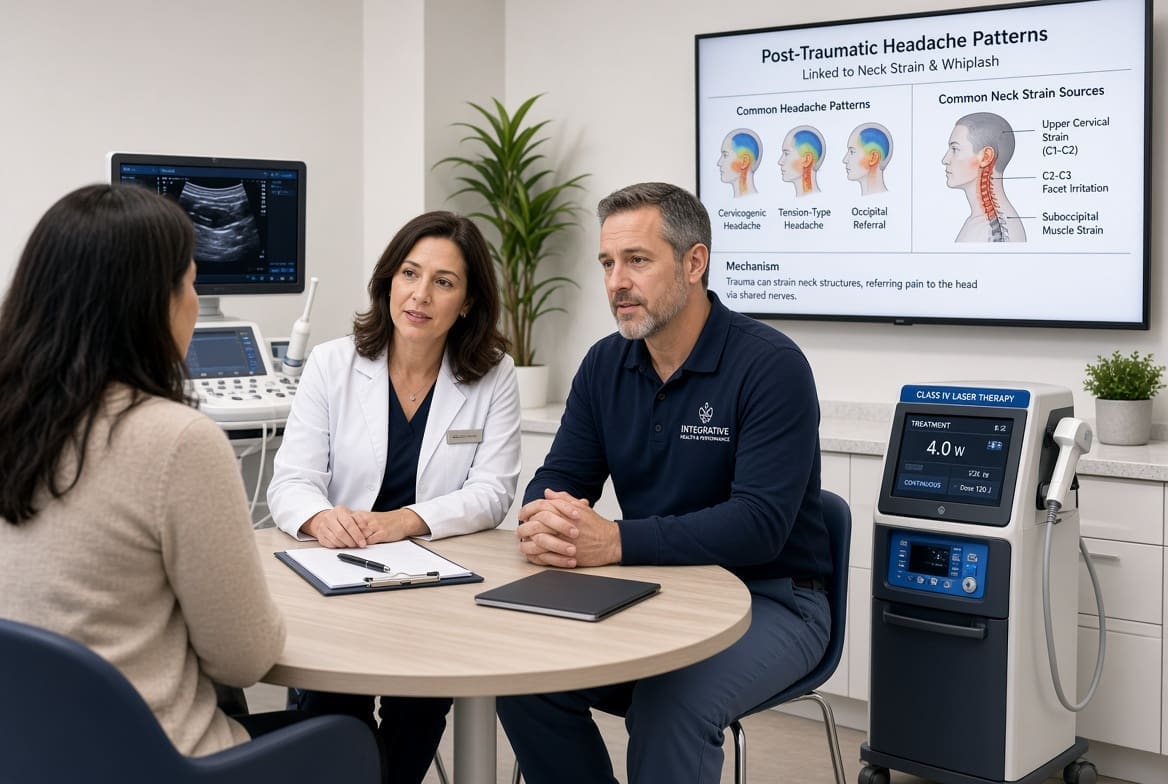
Trauma can produce different headache patterns. Some feel like tension across the forehead and neck. Others begin at the base of the skull and worsen with neck movement (cervicogenic). Still others take on migraine features—throbbing, nausea, light or sound sensitivity—after a collision or whiplash event. Occipital neuralgia and mixed presentations also occur. Because the drivers differ, the supportive tools that help one person may not help another.
A responsible plan starts with medical evaluation to screen for red flags, clarify the phenotype, and rule out overlapping conditions. Only then does recovery coaching layer in nutrition, movement strategies, and advanced supportive options. Patients who track headache days, triggers, sleep, and functional limits gain clearer feedback on what is working. This active role supports autonomy: the patient becomes an informed partner rather than a passive recipient of care.
Nutrition and Lifestyle Coaching: Everyday Tools That Address Root Contributors
Diet and daily habits rarely “cure” a post-traumatic headache on their own, yet they frequently influence frequency and intensity. After injury, inflammation, disrupted sleep, dehydration, and nutrient shortfalls can amplify neck-driven pain or central sensitization. Coaching focuses on practical changes patients can control.
A protein-forward, anti-inflammatory pattern rich in colorful plants, omega-3 sources, and adequate fluids supports tissue repair and may lower background inflammatory tone. Magnesium-rich foods or carefully guided supplementation can help muscle relaxation when levels are low. Consistent sleep timing and hydration reduce common headache amplifiers. Patients learn to log what they eat, how they sleep, and when headaches spike so patterns become visible. These steps align with beneficence—using supportive habits that address modifiable contributors—while remaining low-risk when individualized.
For deeper reading on nutrition after head and neck injury, see the discussion of food, supplements, and integrative approaches at dralexjimenez.com/healing-your-brain-food-supplements-and-chiropractic/ and targeted nutrition strategies at dralexjimenez.com/el-paso-head-and-neck-injury-nutrition-support-strategies/.
Targeted Injections: Precision Options After Screening
When muscle trigger points, facet irritation, or peripheral nerve irritation contribute to headache, image-guided injections may be considered for selected patients. Ultrasound guidance allows precise placement into tight bands or near irritated structures, reducing guesswork. Trigger-point injections, carefully chosen regenerative options, or nerve-focused procedures (for example, in occipital neuralgia patterns) are not first-line for every post-injury headache. They enter the plan after clinical examination shows a clear mechanical or myofascial driver that has not responded adequately to conservative care.
Safety screening is essential. Under medical direction, we review contraindications, medication interactions, and realistic expectations. Patients are coached on post-procedure activity pacing and how to track changes in headache intensity and function. Non-maleficence guides the process: we prefer the least invasive, most evidence-aligned option, and we do not add procedures simply because they are available. Further context on timing and when injections fit is available at dralexjimenez.com/when-we-add-needles-timing-and-treatment-options/ and on trigger-point approaches at dralexjimenez.com/trigger-point-injections-managing-myofascial-pain-effectively/. Occipital neuralgia-specific integrative strategies are outlined at dralexjimenez.com/occipital-neuralgia-relief-with-integrative-care-approaches/.
Spinal Decompression: Mechanical Relief for Selected Disc and Facet Drivers
When disc loading, facet compression, or nerve irritation in the cervical or upper thoracic spine contributes to headache, gentle non-surgical spinal decompression can reduce mechanical stress. The technique uses controlled traction to create space, improve local circulation, and decrease pressure that can refer pain into the head. It is not appropriate for every patient; progressive neurological findings, instability, or other red flags require different care.
In recovery coaching, decompression is paired with active rehabilitation, posture work, and patient education to maintain gains. Patients learn which positions or activities temporarily increase symptoms and how to safely progress loading. This mechanical support complements the other options rather than replacing them. Related post-accident headache management that includes decompression considerations is described at dralexjimenez.com/post-accident-headaches-in-el-paso-pain-relief/.
Advanced IV Nutrient Support: Targeted Delivery When Indicated
Advanced IV nutrient infusions deliver fluids, electrolytes, magnesium, B vitamins, vitamin C, or other selected nutrients directly into the bloodstream. For patients with documented dehydration, poor intake after injury, or confirmed deficiencies that oral routes cannot adequately correct, this route can support tissue repair, muscle function, and energy metabolism more rapidly. It does not replace mechanical care or treat the headache mechanism on its own.
Medical oversight determines candidacy. Screening covers kidney function, cardiovascular status, medication interactions, and realistic goals. Patients track energy, headache frequency, and recovery of daily activities to assess benefit. When used appropriately, IV support fits beneficence by addressing root metabolic or hydration contributors, while non-maleficence keeps the focus on evidence-aligned selection rather than routine wellness use. Details on IV therapy integrated with chiropractic recovery appear at dralexjimenez.com/recover-faster-with-iv-therapy-and-chiropractic-techniques/.
Coordinating Everything Under Dual-Licensure Oversight
These tools work best when coordinated, not stacked independently. Nutrition coaching, decompression, targeted injections, and IV support are selected and sequenced according to the specific headache phenotype, examination findings, and patient goals. Progress is measured with headache diaries, functional scales, and objective motion or strength data so adjustments are data-driven.
What makes Injury Medical Chiropractic and Functional Medicine Clinic unique is combining medical direction and soft-tissue expertise under one roof. Dr. Maria Guadalupe Cardenas, MD, serves as Medical Director and brings extensive internal medicine experience to risk stratification, laboratory interpretation, and overall medical coordination. Dr. Alex Jimenez, DC, APRN, FNP-BC, CFMP, IFMCP, is a dual-licensed clinician who specializes in soft-tissue injury, structural assessment, and advanced rehabilitative and regenerative procedures. This integrated model is one of the few in El Paso, Texas, that can evaluate, document, and deliver these coordinated supportive options for post-injury headache recovery while maintaining clear communication with a patient’s existing medical team.
Patients retain autonomy: they receive plain-language explanations of why a tool is suggested, what realistic results look like, possible side effects, and how to track their own response. Shared records support informed decisions and continuity of care.
These coordinated supportive options reinforce the comprehensive recovery approach detailed in the integrated migraine and headache guides and the broader medical-legal causation resources at dralexjimenez.com. Additional phenotype-specific reading includes the BOTOX clinical guide for appropriately diagnosed chronic migraine at dralexjimenez.com and the seven-pattern integrated headache overview at dralexjimenez.com.
Practical Next Steps for Patients
Start with a thorough evaluation that maps your headache pattern, neck findings, and overall health. Bring a simple diary of headache days, intensity, and triggers. Ask how nutrition, decompression, targeted injections, or IV support might fit—or whether they are not indicated right now. Track changes together with the clinical team so the plan stays individualized and safe. Active participation in recovery coaching turns passive hope into measurable progress while protecting against unnecessary interventions.
References
AbbVie. (2026). BOTOX (onabotulinumtoxinA) prescribing information. rxabbvie.com/pdf/botox_pi.pdf
American Headache Society. (2021). The American Headache Society consensus statement: Update on integrating new migraine treatments into clinical practice. Headache, 61(7), 1021–1039. doi.org/10.1111/head.14153
Headache Classification Committee of the International Headache Society (IHS). (2018). The International Classification of Headache Disorders, 3rd edition. Cephalalgia, 38(1), 1–211. doi.org/10.1177/0333102417738202
Jimenez, A. (2025, November 18). Healing your brain: Food, supplements, and chiropractic. Dr. Alex Jimenez DC, APRN, FNP-BC. dralexjimenez.com/healing-your-brain-food-supplements-and-chiropractic
Jimenez, A. (2025, October 15). Post-accident headaches in El Paso: Pain relief. Dr. Alex Jimenez DC, APRN, FNP-BC. dralexjimenez.com/post-accident-headaches-in-el-paso-pain-relief
Jimenez, A. (2026, August 21). Recover faster with IV therapy and chiropractic techniques. Dr. Alex Jimenez DC, APRN, FNP-BC. dralexjimenez.com/recover-faster-with-iv-therapy-and-chiropractic-techniques
Jimenez, A. (2026, August 31). El Paso head and neck injury nutrition support strategies. Dr. Alex Jimenez DC, APRN, FNP-BC. dralexjimenez.com/el-paso-head-and-neck-injury-nutrition-support-strategies
Jimenez, A. (2026, July 24). Trigger point injections: Managing myofascial pain effectively. Dr. Alex Jimenez DC, APRN, FNP-BC. dralexjimenez.com/trigger-point-injections-managing-myofascial-pain-effectively
Jimenez, A. (2026, September 17). Occipital neuralgia relief with integrative care approaches. Dr. Alex Jimenez DC, APRN, FNP-BC. dralexjimenez.com/occipital-neuralgia-relief-with-integrative-care-approaches
Jimenez, A. (2026, October 6). When we add needles: Timing and treatment options. Dr. Alex Jimenez DC, APRN, FNP-BC. dralexjimenez.com/when-we-add-needles-timing-and-treatment-options
Jimenez, A. (2026, November 3). BOTOX chronic migraine treatment: 2026 clinical guide. Dr. Alex Jimenez DC, APRN, FNP-BC. dralexjimenez.com
Jimenez, A. (2026, November 10). Integrated headache management El Paso: Seven patterns. Dr. Alex Jimenez DC, APRN, FNP-BC. dralexjimenez.com
Pringsheim, T., Davenport, W. J., Mackie, G., Worthington, I., Aube, M., Christie, S. N., Gladstone, J., & Becker, W. J. (2026). Canadian Headache Society systematic review and recommendations for the preventive treatment of migraine. Canadian Journal of Neurological Sciences. (Note: align with most recent AAN/AHS-aligned review cited in clinic materials.)
What's your reaction?