“Knee injuries can present in physically active individuals that lift weights. Can understanding the types of weightlifting knee injuries help in prevention?”
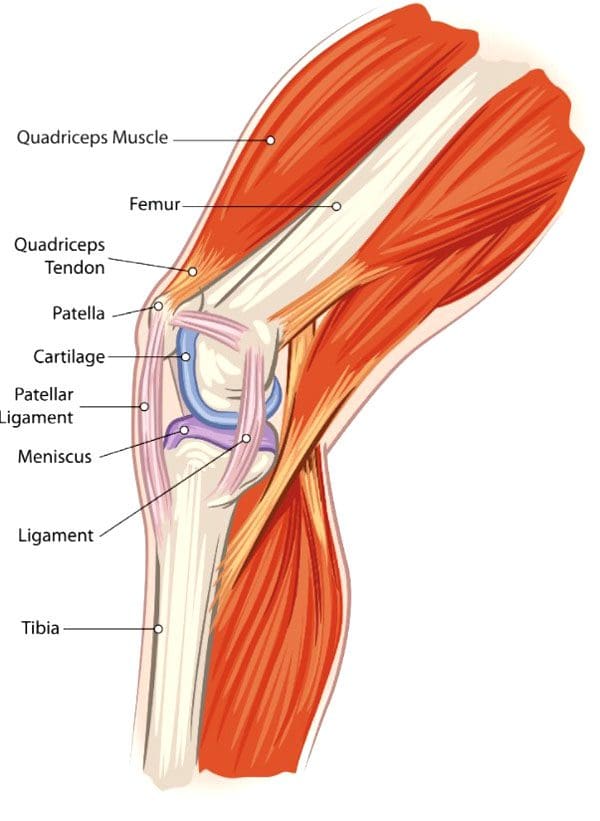
Table of Contents
Weightlifting Knee Injuries
Weight training is very safe for the knees as regular weight training can improve knee strength and prevent injury as long as the correct form is followed. For Individuals with knee injuries from other activities, incorrect weight-training exercises could worsen the injury. (Ulrika Aasa et al., 2017) As well as, sudden twisting movements, poor alignment, and pre-existing injuries can increase the risk of worsening or creating further injuries. (Hagen Hartmann et al, 2013) The body and the knees are designed to support vertical forces on the joints.
Common Injuries
Weightlifting knee injuries occur as the knee joints endure a wide range of stresses and strains. In weight training, the ligaments that attach to the complex bone system of the knee joint can be damaged by incorrect movements, overloading the weight, and increasing the weight too soon. These injuries can result in pain, swelling, and immobility that can range from minor to severe, from a sprain or a slight tear to a complete tear in serious cases.
Anterior Cruciate Ligament – ACL – Injury
This ligament attaches the thigh’s femur bone to the lower leg’s shin bone/tibia and controls excessive rotation or extension of the knee joint. (American Academy of Family Physicians. 2024)
- Anterior means front.
- ACL injuries are seen mostly in athletes but can happen to anybody.
- Severe damage to the ACL usually means surgical reconstruction and up to 12 months of rehabilitation.
- When weightlifting, try to avoid twisting knee movements, intentionally or accidentally, under excessive load.
Posterior Cruciate Ligament – PCL – Injury
- The PCL connects the femur and tibia at different points to the ACL.
- It controls any backward motion of the tibia at the joint.
- Injuries occur most with high-impact forces as a result of accidents and sometimes in activities where forceful trauma to the knee occurs.
Medial Collateral Ligament – MCL – Injury
- This ligament maintains the knee from bending too far to the inside/medially.
- Injuries mostly occur from impact to the outside of the knee or from accidental bodyweight force on the leg that bends at an unusual angle.
Lateral Collateral Ligament – LCL – Injury
- This ligament connects the smaller bone of the lower leg/fibula to the femur.
- It is opposite to the MCL.
- It maintains excessive outward movement.
- LCL injuries occur when a force pushes the knee out.
Cartilage Injury
- Cartilage prevents bones from rubbing together and cushions impact forces.
- Knee menisci are cartilage that cushions the knee joints inside and outside.
- Other types of cartilage protect the thigh and shin bones.
- When cartilage gets torn or damaged, surgery may be required.
Tendonitis
- Aggravated and overused knee tendons can lead to weightlifting knee injuries.
- A related injury known as iliotibial band syndrome/ITB causes pain to the outside of the knee, usually in runners, but it can occur from overuse.
- Rest, stretching, physical therapy, and anti-inflammatory medication are a common treatment plan.
- Individuals should consult a physical therapist for pain lasting longer than two weeks. (Simeon Mellinger, Grace Anne Neurohr 2019)
Osteoarthritis
- As the body ages, normal wear and tear can cause the development of osteoarthritis of the knee joints. (Jeffrey B. Driban et al., 2017)
- The condition causes the cartilage to deteriorate and bones to rub together, resulting in pain and stiffness.
Prevention
- Individuals can minimize their risk of weightlifting knee injuries and pain by following their doctor’s and personal trainers’ recommendations.
- Individuals with an existing knee injury should follow their doctor’s or physical therapist’s recommendations.
- A knee sleeve can keep the muscles and joints secure, providing protection and support.
- Stretching the leg and knee muscles can maintain joint flexibility.
- Avoid sudden lateral movements.
- Possible recommendations can include:
Avoiding Certain Exercises
- Isolation exercises like leg curls, standing, or on a bench, as well as using the leg extension machine, can stress the knee.
Deep Squat Training
Research shows that the deep squat can protect against lower leg injury if the knee is healthy. However, this is when done with proper technique, under expert supervision, and with a gradual progressive load. (Hagen Hartmann et al, 2013)
Individuals should talk to their doctor before beginning a new exercise routine. A personal trainer can provide training in learning the proper technique and weightlifting form.
How I Tore my ACL Part 2
References
Aasa, U., Svartholm, I., Andersson, F., & Berglund, L. (2017). Injuries among weightlifters and powerlifters: a systematic review. British journal of sports medicine, 51(4), 211–219. doi.org/10.1136/bjsports-2016-096037
Hartmann, H., Wirth, K., & Klusemann, M. (2013). Analysis of the load on the knee joint and vertebral column with changes in squatting depth and weight load. Sports medicine (Auckland, N.Z.), 43(10), 993–1008. doi.org/10.1007/s40279-013-0073-6
American Academy of Family Physicians. ACL injury. (2024). ACL injury (Diseases and Conditions, Issue. familydoctor.org/condition/acl-injuries/
Mellinger, S., & Neurohr, G. A. (2019). Evidence based treatment options for common knee injuries in runners. Annals of translational medicine, 7(Suppl 7), S249. doi.org/10.21037/atm.2019.04.08
Driban, J. B., Hootman, J. M., Sitler, M. R., Harris, K. P., & Cattano, N. M. (2017). Is Participation in Certain Sports Associated With Knee Osteoarthritis? A Systematic Review. Journal of athletic training, 52(6), 497–506. doi.org/10.4085/1062-6050-50.2.08
What's your reaction?