Table of Contents
Coaching Through Stress Headaches After an MVA — Understanding the Pattern and Building Recovery Habits
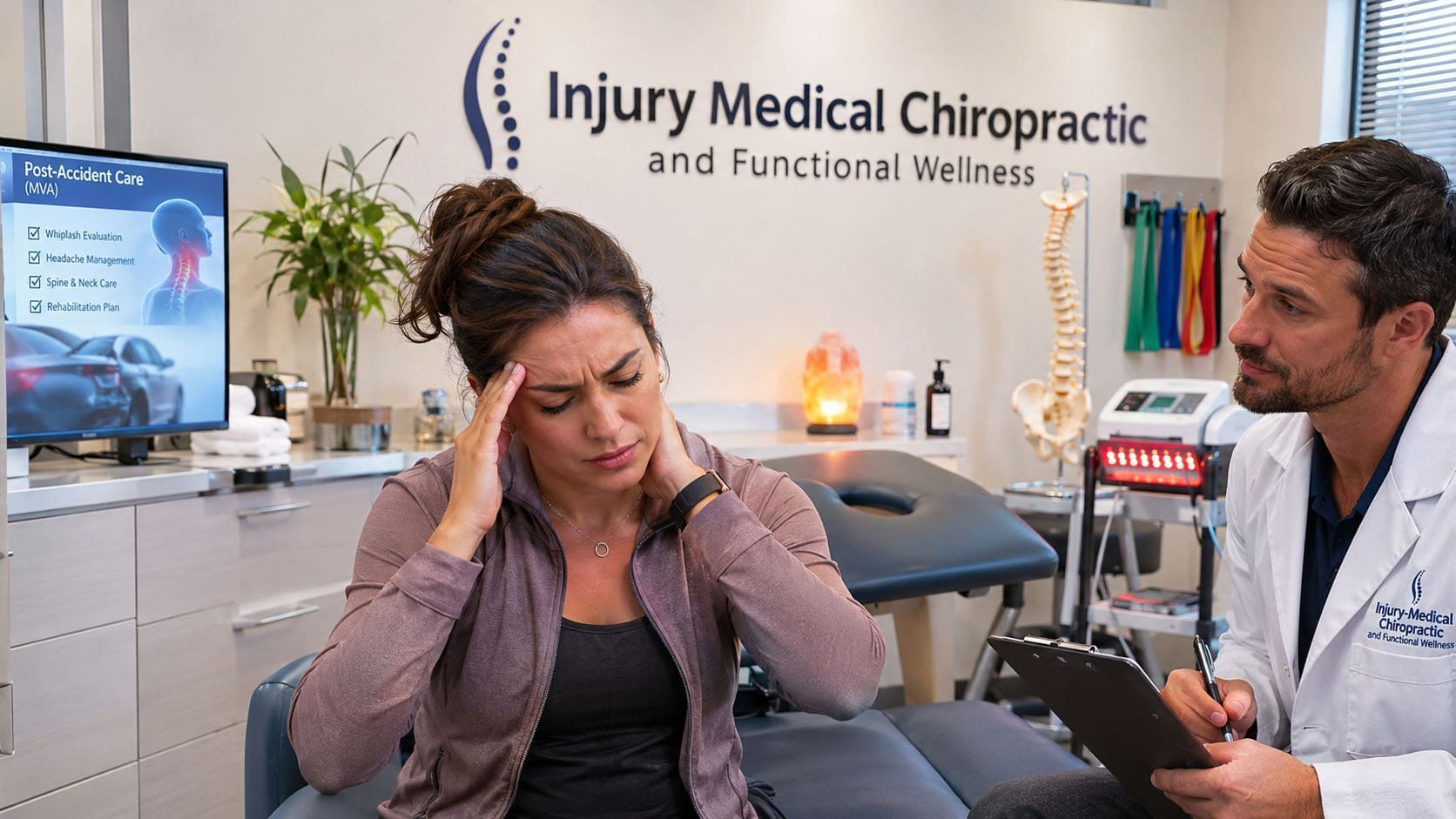
A tight band of pressure across the forehead and temples that starts after a car accident can feel simple at first. Many people call it a “stress headache” and wait for it to fade. After a motor-vehicle collision, that familiar pressure often has a clear physical starting point in the neck and upper shoulders. The same rapid forces that strain muscles and joints can also make the head and neck work harder than before. Understanding the pattern gives patients a practical way to participate in recovery instead of only reacting to pain.
Tension-type features commonly include steady, pressing, or tightening discomfort on both sides of the head. The pain is usually mild to moderate rather than throbbing or one-sided. People often notice it more after long periods of sitting, driving, or looking down at a phone. Neck stiffness, tender spots at the base of the skull, and a sense that the shoulders are “up by the ears” frequently travel with it. These cervical contributors do not mean the headache is imaginary. The upper neck joints and the muscles that attach at the back of the head share nerve pathways with the scalp and face. When those tissues stay irritated after trauma, the brain can register the signals as a band-like headache. Plain-language education helps patients recognize this connection so they can track what makes the pressure better or worse.
Recognizing the Pattern After Trauma
Many patients describe the headache beginning hours or days after the collision rather than at the exact moment of impact. Adrenaline can mask early symptoms. Once protective muscle guarding sets in, the sub-occipital muscles and upper trapezius stay tight. Poor sleep, elevated stress from the accident itself, and changes in daily posture then lower the threshold for the band-like pressure to return.
Common features patients notice include:
- Steady pressure or tightening on both sides of the head
- Greater intensity after prolonged sitting, driving, or phone use
- Neck stiffness or tender spots at the base of the skull
- Shoulder tension that feels like the shoulders are raised toward the ears
- Temporary relief with gentle heat, movement, or short breaks
A simple self-assessment can clarify the picture: Does turning the head or holding a forward head posture increase the pressure? Does gentle movement or heat at the base of the skull ease it? Recording these observations creates a clearer story for both the patient and the clinical team.
Post-traumatic headaches can resemble tension-type patterns even when the original injury involved the neck. Objective findings such as limited cervical motion, palpable muscle tension, or reproduction of the familiar headache during examination help distinguish the mechanical contribution from other causes. Documenting these details early supports recovery and any later need to show how the collision changed the patient’s baseline. Patients who keep a short daily note—pain level, neck tightness, sleep hours, and one activity that helped or worsened symptoms—often discover personal patterns within a week or two.
Coaching Stress Strategies That Fit Real Life
Stress after a collision is not only emotional. The body stays in a guarded state while soft tissues heal. Simple, repeatable strategies can lower that background tension without requiring large blocks of free time.
Practical starting steps include:
- Two-minute breathing pauses (inhale for four counts, exhale for six)
- Brief progressive muscle relaxation focused on the jaw, shoulders, and upper neck
- Regular meals and hydration to avoid blood-sugar dips that raise tension
- Short movement breaks every 30–45 minutes of sitting or driving
- Tracking whether the band-like pressure lessens within 20 minutes of a strategy
Patients frequently start with two-minute breathing pauses performed while seated at a desk or in the car. This interrupts the cycle of shoulder elevation that feeds the headache. Patients can practice progressive muscle relaxation focused on the jaw, shoulders, and upper neck in bed before sleep. Tracking the response turns the exercise into useful feedback rather than another task.
Hydration, regular meals, and short movement breaks also reduce the load on already irritated neck muscles. A patient who notices that skipping lunch reliably brings the pressure by mid-afternoon can plan a brief snack and a neck-friendly stretch instead of waiting for the headache to peak. These adjustments are small enough to sustain and large enough to show measurable change when logged.
Posture and Daily Habits That Support Recovery
Forward head posture places extra demand on the muscles at the base of the skull. After an accident, that demand is harder to ignore. Coaching focuses on frequent micro-adjustments rather than perfect posture held for hours.
Helpful daily cues include:
- Gently drawing the chin back so the ears sit more nearly over the shoulders (hold 10–15 seconds)
- Raising phone or laptop screens so the eyes look slightly downward
- Adjusting the car seat and headrest so the neck stays supported
- Pairing a posture check with existing habits (phone notifications or red lights)
- A quick wall check once or twice a day (heels, buttocks, and shoulder blades lightly touching the wall)
Patients practice the chin-tuck cue while seated or standing. Pairing it with an existing habit makes the practice automatic. Screen height and driving setup also matter. Patients who photograph their typical workstation and driving position, then compare notes after a week of small changes, often see the connection between posture and headache intensity without needing complex equipment.
Sleep and Self-Tracking as Active Tools
Sleep quality strongly influences next-day neck tension and headache threshold. Coaching encourages consistent wind-down routines and simple tracking so patients can see what actually helps.
Useful sleep and tracking habits include:
- Dim lights and limited late caffeine in the hour before bed
- A brief body scan that releases shoulder and jaw tension
- A supportive pillow that fills the space between the neck and mattress
- Consistent sleep and wake times when possible
- A short daily note: date, headache intensity (0–10), neck tightness, sleep quality, and one helpful or aggravating factor
Keeping the bedroom cool and using a supportive pillow helps maintain better alignment overnight. Patients track sleep hours and morning neck stiffness alongside headache intensity. Over several days, the log frequently shows that nights with better sleep correlate with milder band-like pressure the following afternoon.
Self-tracking does not replace clinical care. It provides the patient with ownership of daily data to share at appointments. When the pattern improves with specific habits, the patient sees the result directly. When symptoms persist, or new warning signs appear—sudden severe headache, progressive weakness, visual changes, or confusion—the same tracking makes the need for prompt medical evaluation obvious.
Bioethical Foundations of Patient-Centered Coaching
Beneficence is served when education and practical habits increase engagement and improve day-to-day outcomes. Patients who understand the cervical contribution and practice targeted strategies often report fewer severe headache days and greater confidence returning to work or driving. Early flagging of warning signs protects non-maleficence. Coaching explicitly teaches which symptoms require same-day medical attention so that non-invasive approaches are never used in place of needed urgent care. Autonomy is central: the patient owns the process and the decisions. Self-tracking, posture cues, and stress strategies are tools the individual can use independently while remaining free to coordinate with any existing medical providers.
What Makes This Approach Available in El Paso
Injury Medical Clinic PA is one of the only clinics in El Paso, Texas, that provides these integrated treatments under a dual-licensure model. Dr. Maria Guadalupe Cardenas, MD, serves as Medical Director and brings decades of internal medicine experience to complex recovery planning. Dr. Alex Jimenez, DC, APRN, FNP-BC, specializes in soft-tissue injury evaluation and care, bridging structural findings with medical oversight. Together, they support patients who want both clinical guidance and practical coaching tools for stress-related and cervically influenced headaches after trauma. The same team documents objective findings that help clarify how the collision contributed to the current pattern, while patients retain control over daily recovery habits.
This kind of patient-centered education supports the broader clinical resources available at dralexjimenez.com. Related pages that expand on post-traumatic headache patterns, cervical contributions, and integrated management include the explanations of causes after accidents, causation insights for headache care, and the overview of seven common headache patterns. These resources help patients and their clinicians stay aligned on both the mechanical factors and the medical evaluation that may be needed.
Recovery after a motor-vehicle collision is rarely passive. When band-like head pressure appears, understanding its frequent link to neck strain, practicing brief stress and posture strategies, protecting sleep, and tracking personal responses give patients an active role. The result is clearer communication with the care team, earlier recognition of warning signs, and greater ownership of the steps that support lasting improvement.
References
Headache Classification Committee of the International Headache Society (IHS). (2018). The International Classification of Headache Disorders, 3rd edition. Cephalalgia, 38(1), 1–211. doi.org/10.1177/0333102417738202
Ashina, S., Mitsikostas, D. D., Lee, M. J., Yamani, N., Wang, S.-J., Messina, R., Ashina, H., Buse, D. C., Pozo-Rosich, P., Jensen, R. H., Diener, H.-C., & Lipton, R. B. (2021). Tension-type headache. Nature Reviews Disease Primers, 7, 24. doi.org/10.1038/s41572-021-00257-2
Schwedt, T. J. (2024). Post-traumatic headache: Epidemiology, clinical features, and management. Continuum, 30(2), 411–424. doi.org/10.1212/CON.0000000000001404
Castaldo, M., Arendt-Nielsen, L., & Di Antonio, S. (2025). Cervical musculoskeletal impairments and pain sensitivity in patients with post-traumatic headache. The Journal of Headache and Pain, 26, Article 45. doi.org/10.1186/s10194-025-01980-1
Sterling, M., Hendrikz, J., & Kenardy, J. (2010). Compensation claim lodgement and health outcome developmental trajectories following whiplash injury: A prospective study. Pain, 150(1), 22–28. doi.org/10.1016/j.pain.2010.02.013
Di Antonio, S., Arendt-Nielsen, L., & Castaldo, M. (2023). Cervical musculoskeletal impairments and pain sensitivity in migraine patients. The Journal of Headache and Pain, 24, Article 112. doi.org/10.1186/s10194-023-01645-3
What's your reaction?