Power walking is a fast-paced walking activity quicker than a typical walking pace. It is an exercise technique emphasizing speed and arm motion to increase health benefits. It’s not as high impact as jogging but significantly increases heart rate. Adding power walking to an overall health regimen can improve cardiovascular, joint, muscle, and overall wellness.
Table of Contents
 Power Walking
 Power Walking
- Power walking is considered from 3 mph to 5 mph and focuses on speed and arm motion to increase heart rate.
- Power walking demands more from the cardiovascular system.
- Because it requires more steps per minute, the heart rate will increase more than from a regular walk.
- This makes for a more intense cardiovascular workout that burns more calories.
Benefits
Power walking is a great way to improve fitness, heart and joint health, and mental well-being. It has been shown to decrease diabetes risk and lower high blood pressure and some cancers. Other benefits include:
Improves Life Span
- The National Institutes of Health recognize the benefits of walking, including a reduced risk of all-cause mortality.
Cardiovascular
- Power walking will raises the heart rate into the moderate-intensity zone.
- This zone improves cardiovascular health, lowering resting heart rate and strengthening the heart.
Lowers Risk of Health Conditions
- Lowers the risk of several conditions like heart disease, dementia, and type 2 diabetes.
- Improves sleep quality, reduces sleep disorders’ risks, increases brain function, and supports bone health.
Strengthens Muscles and Bones
- It releases pressure from the joints and the muscles and increases the body’s overall range of motion.
Quality of Life
- It improves the quality of life as the body becomes more fit.
- Reduces risk of illnesses.
- Mental abilities and performance improve with increased circulation.
- Attention, concentration, and motivation improve.
Technique Overview
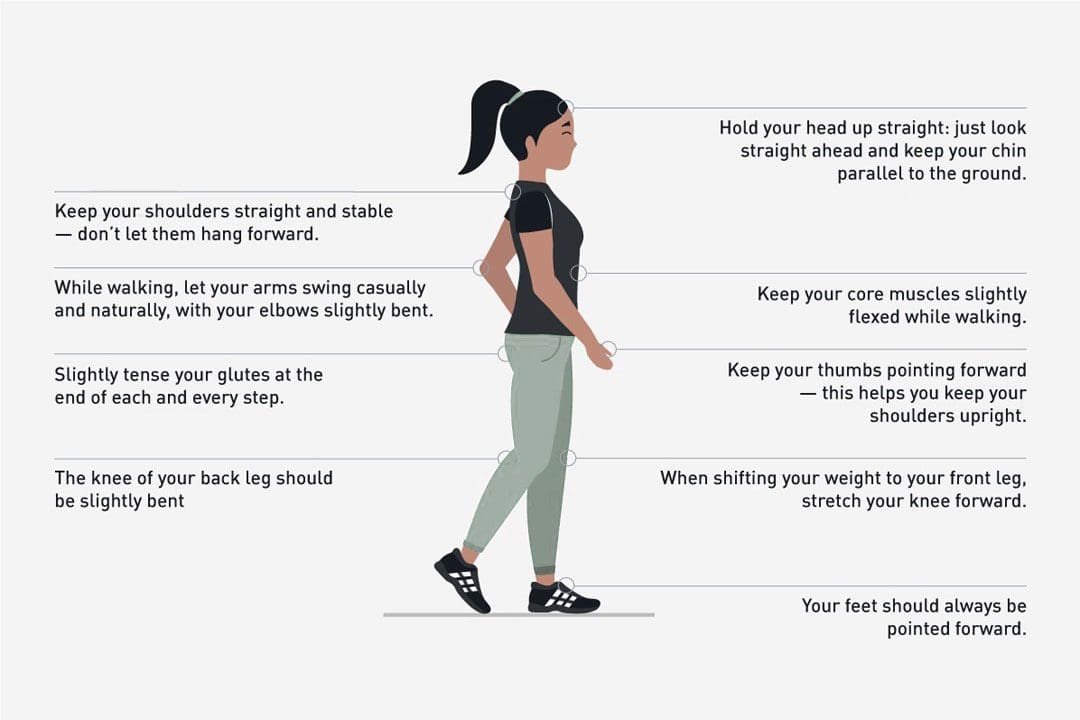
Optimal power walking technique will maximize benefits and prevent injuries. Some recommended guidelines to follow:
Posture Awareness
The right posture will help the body maintain speed and will help protect/prevent injury.
- Eyes forward, shoulders back, and head upright.
- Pull your belly button in toward the spine to engage the core muscles.
- If you start to slump forward, take a moment to correct your body position.
- If you start holding tension in the shoulders and neck, take a moment to relax and release them.
Gently Swing Arms
- Arms bent at around 90 degrees.
- Move the arms up and back so the opposite arm and leg advance together.
- If the right foot is stepping forward, the left arm should also go forward.
- Adding arm motion increases speed.
- Focus on controlling the range of motion.
- The hand should not rise higher than the collarbone and should not cross the body’s center.
Walking Pattern
- With every step, land on the heel and roll the foot toward the toes.
- Concentrate on moving the hips forward and not side to side.
Movement
- Use short strides and try for a quick pace.
- Studies have shown that taking more steps per minute can positively impact insulin levels, body mass index, and waist circumference.
- Gradually work up to longer distances and increased speed.
Chiropractic
Chiropractic care can improve exercise experience, athletic performance, and sports performance. A few benefits include the following:
- Increased limberness of the joints, ligaments, and tendons.
- Increased elasticity and flexibility of the muscles.
- Nervous system support improving response time, speed, and endurance.
Physical activity, no matter what intensity, is vital for health. If you are considering beginning an exercise program, talk to your doctor about developing a training program.
How To Walk Faster
References
Dunlop DD, et al. (2019). One hour a week: Moving to prevent disability in adults with lower extremity joint symptoms. DOI: 10.1016/j.amepre.2018.12.017
Mayo Clinic Staff. (2019). Walking: Trim your waistline, and improve your health. mayoclinic.org/healthy-lifestyle/fitness/in-depth/walking/art-20046261
Sharma, Ashish, et al. “Exercise for mental health.” Primary care companion to the Journal of clinical psychiatry vol. 8,2 (2006): 106. doi:10.4088/pcc.v08n0208a
Tudor-Locke, Catrine, et al. “Step-Based Physical Activity Metrics and Cardiometabolic Risk: NHANES 2005-2006.” Medicine and science in sports and exercise vol. 49,2 (2017): 283-291. doi:10.1249/MSS.0000000000001100
What's your reaction?