“For individuals with lower back pain, it could be quadricep muscle tightness causing the symptoms and posture problems. Can knowing the signs of quadricep tightness help prevent pain and avoid injury?”
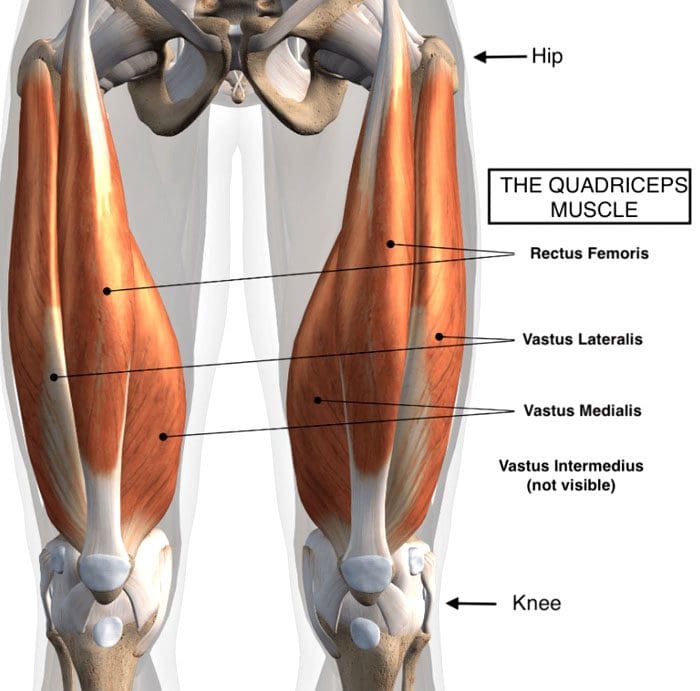
Table of Contents
Quadriceps Tightness
Quadriceps muscles are in the front of the thigh. Forces that could be creating chronic pain and posture problems could be happening at the same time are:
- Quadricep tightness causes lower back pain as the pelvis gets pulled down.
- Tight quadriceps lead to weakened hamstring muscles.
- These are the opposing muscles behind the thigh.
- Stress and pressure on the hamstrings can cause back pain and problems.
- Pelvic alignment becomes affected, causing posture problems and increased pain symptoms. (Sai Kripa, Harmanpreet Kaur, 2021)
Quadriceps Tightness Pulls the Pelvis Down
One of the four muscles in the quadriceps group:
- The rectus femoris attaches to the pelvis at the anterior superior iliac spine, which is the front part of the hip bone.
- The rectus femoris is the only muscle in the group that crosses over the hip joint, which also affects movement.
- When the quadriceps, especially the rectus femoris, become tight, they pull down on the hips.
- The pelvis tilts downward or forward, technically referred to as the anterior tilt of the pelvis. (Anita Król et al., 2017)
- The spine is between the pelvis, and if the pelvis tilts forward, the lumbar spine compensates by arching.
- A larger arch in the lower back is referred to as excessive lordosis and often causes tightness and pain in the back muscles. (Sean G. Sadler et al., 2017)
Hamstring Compensation
- When the quadriceps tighten and the pelvis gets pulled down, the back has an abnormal lift. This puts the hamstring on a consistent stretch that can cause pain symptoms.
- Healthy posture and hamstring muscle tone help maintain correct pelvic positioning in the back.
- This is correct because it helps maintain a comfortable position.
- Quadricep tightness can set off a reaction as the pelvis tilts down in front and up in the back while overly stretching the hamstrings.
- Pain and soreness are the usual result
- Lack of hamstring strength and quadriceps stretching can cause the hamstrings to lose their ability to support correct pelvic and spinal positions. (American Council on Exercise. 2015)
Knowing When Quads Are Tightening
- Individuals often don’t realize their quadriceps are tight, especially those who spend most of the day sitting.
- The more time spent in a chair can cause the quadriceps and lower back muscles to tighten steadily.
Individuals can try a few tests at home:
Standing Up
- Push the hips forward.
- Push from the sitting bones so you’re at the correct level.
- How far forward do the hips go?
- What is felt?
- Pain could indicate tight quadriceps.
In A Lunge Position
- With one leg forward and bent in front of the other.
- The back leg is straight.
- How far forward does the leg go?
- What is felt?
- How does the front of the hip on the back leg feel?
Standing Bent Leg
- Stand with the front leg bent and the back leg straight.
- Discomfort in the back leg could mean tight quadriceps.
In A Kneeling Position
- Arch the back
- Grab the ankles
- Modify the position to adjust for any pain or joint issues.
- If you have to prop yourself up or modify the pose to reduce pain, it could be tight quadriceps.
- Helping to understand the condition can help in communication with a healthcare provider.
- A healthcare provider and/or physical therapist can conduct a posture evaluation examination to test the quadriceps.
Understanding Academic Low Back Pain: Impact and Chiropractic Solutions
References
Kripa, S., Kaur, H. (2021). Identifying relations between posture and pain in lower back pain patients: a narrative review. Bulletin of Faculty of Physical Therapy, 26(34). doi.org/doi: 10.1186/s43161-021-00052-w
Król, A., Polak, M., Szczygie?, E., Wójcik, P., & Gleb, K. (2017). Relationship between mechanical factors and pelvic tilt in adults with and without low back pain. Journal of back and musculoskeletal rehabilitation, 30(4), 699–705. doi.org/10.3233/BMR-140177
Sadler, S. G., Spink, M. J., Ho, A., De Jonge, X. J., & Chuter, V. H. (2017). Restriction in lateral bending range of motion, lumbar lordosis, and hamstring flexibility predicts the development of low back pain: a systematic review of prospective cohort studies. BMC musculoskeletal disorders, 18(1), 179. doi.org/10.1186/s12891-017-1534-0
American Council on Exercise. (2015). 3 Stretches for Opening Up Tight Hips (Fitness, Issue. www.acefitness.org/resources/everyone/blog/5681/3-stretches-for-opening-up-tight-hips/
What's your reaction?