The hamstring muscles attach, through a tendon called the proximal hamstring tendon, to the ischial tuberosity, the bones used to sit deep in the buttock muscles. When the tendon is subjected to overuse/repetitive stresses and strains, the internal structure can become compromised, leading to weakness and pain symptoms. This is known as proximal hamstring tendinopathy. Tendinopathy is an overuse injury where the tendon is repeatedly strained until microscopic tears form. It is common in athletes that do a lot of running but also in individuals that sit for prolonged periods. If left untreated, high hamstring tendinopathy can lead to progressive degeneration of the tissues, leading to chronic weakness, pain, and dysfunction.
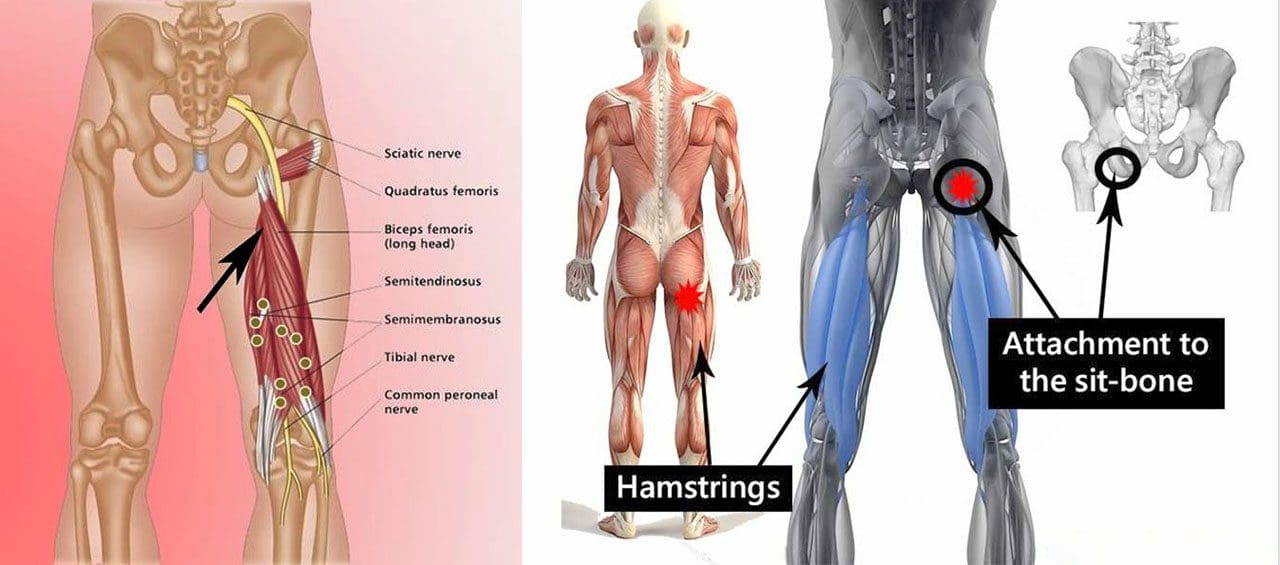
Table of Contents
High Hamstring Tendinopathy
The hamstrings are a powerful muscle group that extends the hip and flexes the knee. They experience stress and pressure during activity and inactivity/sitting and are susceptible to strain injuries. Tendons attach muscle to bone and are designed to take compressive and tensile weight/loads that stretch or flex. A tendon is made up of fibrous tissue containing organized type 1 collagen. Tendons receive blood; however, the supply is less where the tendon attaches to the bone and is commonly where tendinopathy occurs.
Injury
A hamstring injury involves the bruising, irritation, or tearing of the hamstring tendon or muscle tissue. Severity can range from:
- Microtears that cause stiffness and pain symptoms but heal fast on their own.
- Severe ruptures that cause debilitating pain, dysfunction and require medical intervention.
The tendon attaches to the ischial tuberosity or sitting buttock bone. Tendons can have a spasm-like reaction to sudden or quick shift changes. A sudden change can cause adverse changes to the tendon. Too much load on the tendon beyond its ability to recover can cause the structure to change and the collagen to break down/tear like a rope tearing and unraveling. High hamstring tendinopathy happens around the hip area and presents as buttock or upper thigh pain. Individuals report deep, dull, radiating buttock pain during walking, running, and prolonged sitting or driving. Sometimes the sciatic nerve can become irritated or entrapped by an affected tendon’s scar tissue, causing sciatica-like symptoms.
Stages of Tendon Pathology
Reactive Phase
- Caused by an acute overload of physical activity or inactivity.
- The tendon will thicken temporarily to decrease the stress; however, there may be no inflammation.
- The tendon can return to normal if the load is reduced or sufficient time for recovery and repair is allowed.
Disrepair
- Chronically overloaded.
- Unsuccessful healing.
- More negative tendon changes occur.
- Reversibility is possible with load management and targeted exercises to stimulate the tendon and surrounding tissues.
Degenerative
- Continual progression of adverse tendon changes.
- More common in older individuals.
- Continue load management and strength training to maximize the tendon’s tolerance.
Chiropractic Treatment
A chiropractic therapy team will develop a personalized treatment program to improve tendon structure and strengthen the hamstrings, gluteal, and side abdominal muscles. They will begin with tendon symptom-relieving massage to loosen the muscles and get the blood circulating, MET-targeted stretches to lengthen the muscles, and spinal and pelvic adjustments to realign the body.
Sciatica Explained
References
Buckley, Mark R et al. “Distributions of types I, II and III collagen by region in the human supraspinatus tendon.” Connective tissue research vol. 54,6 (2013): 374-9. doi:10.3109/03008207.2013.847096
Lempainen, Lasse, et al. “Expert opinion: diagnosis and treatment of proximal hamstring tendinopathy.” Muscles, ligaments, and tendons journal vol. 5,1 23-8. 27 Mar. 2015
Mattiussi, Gabriele, and Carlos Moreno. “Treatment of proximal hamstring tendinopathy-related sciatic nerve entrapment: presentation of an ultrasound-guided “Intratissue Percutaneous Electrolysis” application.” Muscles, ligaments, and tendons journal vol. 6,2 248-252. 17 Sep. 2016, doi:10.11138/mltj/2016.6.2.248
Ono, T et al. “Estimation of tensile force in the hamstring muscles during overground sprinting.” International Journal of sports medicine vol. 36,2 (2015): 163-8. doi:10.1055/s-0034-1385865
White, Kristin E. “High hamstring tendinopathy in 3 female long-distance runners.” Journal of chiropractic medicine vol. 10,2 (2011): 93-9. doi:10.1016/j.jcm.2010.10.005
Wilson, Thomas J et al. “Sciatic Nerve Injury After Proximal Hamstring Avulsion and Repair.” Orthopedic Journal of sports medicine vol. 5,7 2325967117713685. 3 Jul. 2017, doi:10.1177/2325967117713685
What's your reaction?