The brain and body need macronutrients that include carbohydrates, fats, and protein in the right amounts to energize the body. About half of the calories should come from carbohydrates, 30% from fat, and 20% from protein. Food energy density is the amount of energy, represented by the number of calories, in a specific weight measurement.
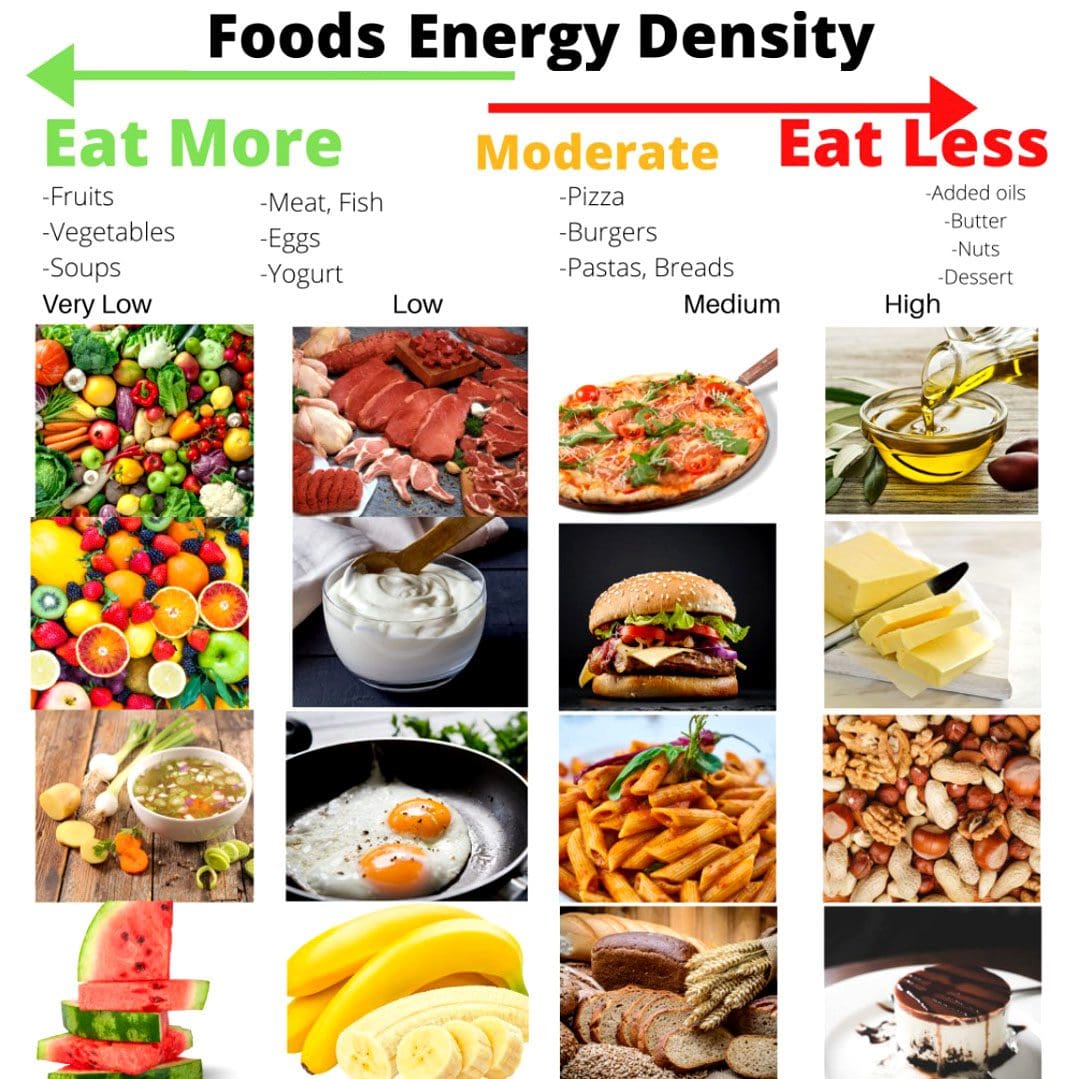
Table of Contents
Food Energy Density
Energy density is determined by the proportion of macronutrients – protein, fat, carbohydrates, fiber, and water.
- Energy-dense foods are high in calories per serving.
- Foods with large amounts of fiber and water have a lower density.
- Foods high in fat have an increased energy density.
- An example of a high-energy-density food is a donut because of the high-calorie count from the sugar, fat, and small serving size.
- An example of a low-energy-density food is spinach because it only has a few calories in a whole plate of raw spinach leaves.
Energy Dense Foods
Energy-dense foods contain a high number of calories/energy per gram. They are typically higher in fat and lower in water. Examples of energy-dense foods include:
- Full-fat dairy
- Butter
- Cheese
- Nut butter
- Fatty cuts of meat
- Starchy vegetables
- Thick sauces
- Nuts
- Seeds
Less nutrient-dense foods include:
- Sweets
- Deep-fried foods
- French fries
- Pasta
- Crackers
- Chips
Foods like soups and beverages can be either high or low energy density depending on the ingredients. Broth-based soups with vegetables usually have low density while creamed soups are energy-dense. Non-fat milk is less dense than regular milk, and diet soda is less dense than regular soda.
Low Energy Dense Foods
- Foods with low energy density include high-fiber green and colorful vegetables.
- Foods with low energy density are often nutrient-dense, which means they have plenty of nutrients per serving size.
- Many fruits, berries, and vegetables are low in calories, high in fiber, and packed with vitamins and minerals.
- Foods high in water content like citrus fruits and melons are usually less energy-dense.
- Low-calorie foods often have a low energy density, but not always.
- It’s important to read nutrition labels to know how many calories are being provided daily.
Weight Management
- Weight management is about watching how many calories are taken in and how many calories are burned.
- Filling up on foods with low energy density will cause the body to feel satisfied while eating fewer high-density calories.
- Plan all meals so they include foods with a low energy density and high in nutrients.
- However, the opposite can happen if individuals eat mostly low-energy-dense foods, will need a larger volume of food to fill up, and as a result, will take in more calories.
- This is not ideal for losing weight, but it could be helpful if trying to gain weight.
- High-energy-dense foods that are nutritious include avocados, nuts, and seeds.
Adjustment Recommendations
Add More Fruits and Vegetables To The Plate
- At least half of a plate should be covered with low-calorie fruits and vegetables.
- Berries are sweet and delicious and provide antioxidants
- Leave a quarter of the plate for the protein, and the remaining quarter can hold a serving of starchy foods like pasta, potatoes, or rice.
- Eating more fruits and vegetables will partially fill the body leading to eating less high-energy-dense foods.
- Picky eaters should try various recipes, sooner or later, they will discover something they enjoy.
Start With Salad or a Bowl of Clear Broth Soup
- Soups and salads will fill the body before the main energy-dense course like pasta, pizza, or another high-calorie food.
- Avoid heavy cream-based salad dressings and creamed soups.
- Water has zero calories and drinking a few glasses can help suppress the hunger until the next meal, or a low-density snack.
From Consultation to Transformation
References
www.cdc.gov/nccdphp/dnpa/nutrition/pdf/r2p_energy_density.pdf
Fernandez, Melissa Anne, and André Marette. “Potential Health Benefits of Combining Yogurt and Fruits Based on Their Probiotic and Prebiotic Properties.” Advances in nutrition (Bethesda, Md.) vol. 8,1 155S-164S. 17 Jan. 2017, doi:10.3945/an.115.011114
Horgan, Graham W et al. “Effect of different food groups on energy intake within and between individuals.” European Journal of Nutrition vol. 61,7 (2022): 3559-3570. doi:10.1007/s00394-022-02903-1
Hubbard, Gary P et al. “A systematic review of compliance to oral nutritional supplements.” Clinical nutrition (Edinburgh, Scotland) vol. 31,3 (2012): 293-312. doi:10.1016/j.clnu.2011.11.020
Prentice, A M. “Manipulation of dietary fat and energy density and subsequent effects on substrate flux and food intake.” The American Journal of clinical nutrition vol. 67,3 Suppl (1998): 535S-541S. doi:10.1093/ajcn/67.3.535S
Slesser, M. “Energy and food.” Basic life sciences vol. 7 (1976): 171-8. doi:10.1007/978-1-4684-2883-4_15
Specter, S E et al. “Reducing ice cream energy density does not condition decreased acceptance or engender compensation following repeated exposure.” European Journal of clinical nutrition vol. 52,10 (1998): 703-10. doi:10.1038/sj.ejcn.1600627
Westerterp-Plantenga, M S. “Effects of the energy density of daily food intake on long-term energy intake.” Physiology & behavior vol. 81,5 (2004): 765-71. doi:10.1016/j.physbeh.2004.04.030
What's your reaction?