The Adams forward bend test is a simple screening method that can help with scoliosis diagnosis and help in developing a treatment plan. The exam is named after the English physician William Adams. As part of an examination, a doctor or chiropractor will look for an abnormal side-to-side bend in the spine.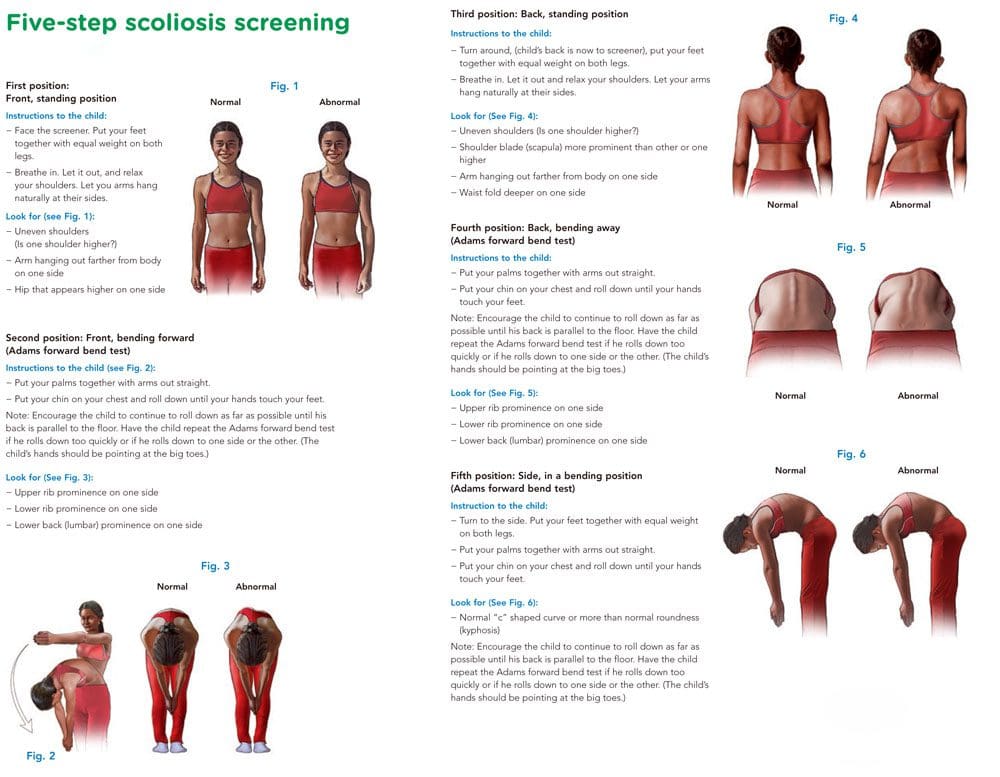
Table of Contents
Scoliosis Diagnosis
- The Adams forward-bend test can help determine if there are indicators for scoliosis.
- It is not an official diagnosis, but the results can be used as a starting point.
- The test is done with school-age children between 10 and 18 to detect adolescent idiopathic scoliosis or AIS.
- A positive test is a noticeable asymmetry in the ribs with a forward bend.
- It can detect scoliosis in any part of the spine, especially in the thoracic middle and upper back.
- The test is not only for kids; scoliosis can develop at any age, so it is also effective for adults.
Adams Forward Bend Test
The test is quick, easy, and painless.
- The examiner will check to see if anything is uneven when standing straight.
- Then the patient will be asked to bend forward.
- The patient is asked to stand with their legs together, facing away from the examiner.
- Then patients bend forward from the waist, with arms hanging vertically downward.
- The examiner uses a scoliometer-like level to detect asymmetries within the spine.
- Deviations are called the Cobb angle.
The Adams test will reveal signs of scoliosis and/or other potential deformities like:
- Uneven shoulders
- Uneven hips
- Lack of symmetry between the vertebrae or the shoulder blades.
- The head does not line up with a rib hump or the pelvis.
Detection of Other Spinal Issues
The test can also be used to find spinal curvature issues and conditions like:
- Kyphosis or hunchback, where the upper back is bent forward.
- Scheuermann’s disease is a form of kyphosis where the thoracic vertebrae can grow unevenly during a growth spurt and cause the vertebrae to develop into a wedge-like shape.
- Congenital spine conditions that cause an abnormal curve of the spine.
Confirmation
The Adams test by itself is not enough to confirm scoliosis.
- A standing X-ray with Cobb angle measurements above 10 degrees is required for diagnosing scoliosis.
- The Cobb angle determines which vertebrae are tilted the most.
- The higher the angle, the more severe the condition and the more probable it will produce symptoms.
- Computed tomography or CT and magnetic resonance imaging or MRI scans can also be used.
Forward Bend Test
References
Glavaš, Josipa et al. “The role of school medicine in the early detection and management of adolescent idiopathic scoliosis.” Wiener klinische Wochenschrift, 1–9. 4 Oct. 2022, doi:10.1007/s00508-022-02092-1
Grossman, T W et al. “An evaluation of the Adams forward bend test and the scoliometer in a scoliosis school screening setting.” Journal of pediatric orthopedics vol. 15,4 (1995): 535-8. doi:10.1097/01241398-199507000-00025
Letts, M et al. “Computerized ultrasonic digitization in the measurement of spinal curvature.” Spine vol. 13,10 (1988): 1106-10. doi:10.1097/00007632-198810000-00009
Senkoylu, Alpaslan, et al. “A simple method for assessing rotational flexibility in adolescent idiopathic scoliosis: modified Adam’s forward bending test.” Spine deformity vol. 9,2 (2021): 333-339. doi:10.1007/s43390-020-00221-2
What's your reaction?