Incorrect manual handling and lifting is a leading cause of workplace injuries. Can health and safety training help reduce injuries and lost workdays?
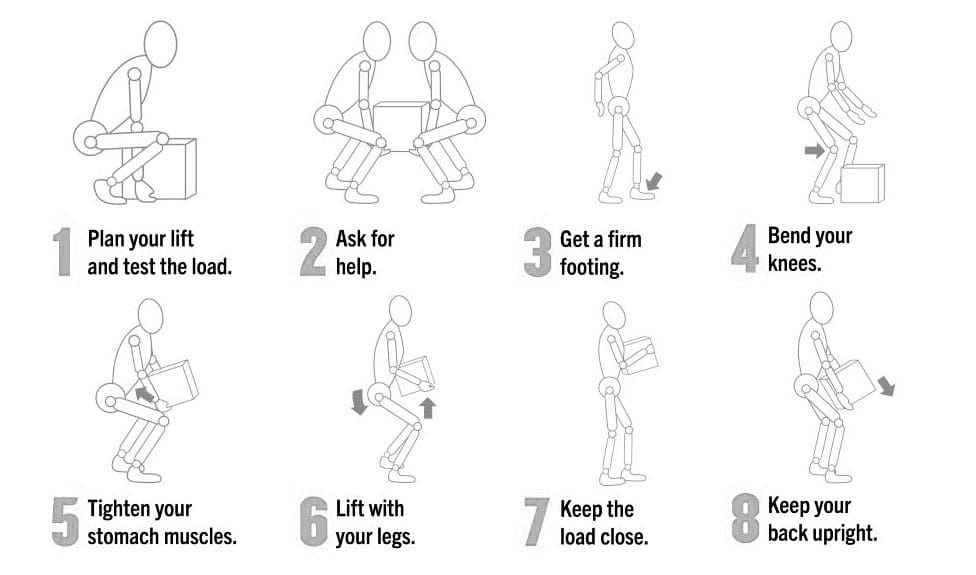
Table of Contents
Correct Manual Lifting Technique
Manually lifting objects using incorrect techniques can lead to acute back injuries, herniated discs, sciatica, and long-term issues like increased risk of reinjury, body misalignment, and chronic back pain. Individuals can prevent spinal disc compression and/or lower back muscle strain by learning to use correct manual lifting techniques. (CDC. The National Institute for Occupational Safety and Health (NIOSH). 2007)
Lifting Guide
Individuals can protect their backs and prevent injury by following simple steps when lifting objects.
Support Base
- Ensure there is a healthy support base from which to lift.
- Keep feet shoulder-width apart with one foot slightly in front of the other.
Ask For Help
- If coworkers or colleagues are available, ask for assistance.
- If the load is too heavy, ask for help lifting and moving the object/s.
Use Mechanical Assistant Devices
- Use hand trucks, dollies, or pushcarts whenever possible for uneven and heavy loads.
Squat To Lift Object
- Bend at the hips and knees only, not the back.
- Put one knee on the ground to ensure stability before lifting.
Check Posture
- Looking straight ahead, maintain posture upright with the chest out, shoulders back, and lower back slightly arched.
Lift Slowly
- Lift with the knees and hips only, gradually straightening the lower back.
Load Positioning
- Once upright, hold the load close to the body around the stomach.
Move and Maintain Alertness
- Always take small steps.
- Maintain alertness as to where you are going.
- Keep the shoulders square with the hips when changing directions to avoid twisting and losing or shifting balance.
Rest
- If you are fatigued, set the load/object down and rest for a few minutes until you can fully engage in the task.
Squat To Set Object Down
- Squat with the knees and hips and set the load down slowly.
- Avoid quickly rising and jerking movements, and allow the legs, hips, and back muscles to reset.
Planning and Tips
Lifting anything heavy takes planning to prevent muscle spasms, back strain, and other musculoskeletal injuries. Considerations to keep in mind:
Make a Plan Before Lifting
- Knowing what object/s are being lifted and where they are going will prevent individuals from making awkward movements while holding and carrying something heavy.
- Set and clear a path.
- If lifting something with another person, ensure both agree and understand the plan.
Lift Close to The Body
- Individuals are stronger and more stable lifters if the object is held close to their body rather than at the end of their reach.
- Make sure there is a firm hold on the object.
- It is easier to maintain balance close to the body.
Maintain Feet Shoulder-Width Apart
- Keep the feet about shoulder-width apart.
- Having a solid base of support is important while lifting.
- Placing the feet too close together will cause instability while placing them too far apart will hinder movement.
- Take short steps.
Visualize The Motions Involved and Practice The Motions Before Lifting
- Think about the motion before lifting.
- Practice the lifting motion before lifting the object.
- Focus on keeping the spine straight.
- Raise and lower to the ground by bending the knees.
- Avoid bending at the waist or hips.
Tighten the Stomach Muscles
- Tightening the abdominal muscles will hold the back in a healthy lifting position and help prevent excessive force on the spine.
Lift With the Legs
- The legs are stronger than the back muscles, so let the leg strength do the work.
- Lower yourself to the ground by bending the knees, not the back.
Keep Eyes Up
- Looking slightly upwards will help maintain a better spine position and help keep the back straight.
Avoid Twisting or Bending
- Face in the direction you are walking.
- Stop, take small steps, and continue walking if turning is required.
Back Belts
It has become common for many who work in jobs requiring manual lifting to wear back belts or support. However, research does not show that they decrease the risk of a lifting injury. (CDC and The National Institute for Occupational Safety and Health, 2023) Instead, it is recommended that the belt be thought of as a reminder of where the back muscles are positioned to keep the individual aligned, combined with the correct lifting techniques.
Injury Medical Chiropractic and Functional Medicine Clinic
Training the body and maintaining its optimal health for correct manual lifting techniques requires daily efforts through practice, conscious position corrections, and ergonomics. Injury Medical Chiropractic and Functional Medicine Clinic works with primary healthcare providers and specialists to develop an optimal health and wellness solution. We focus on what works for you to relieve pain, restore function, and prevent injury. Regarding musculoskeletal pain, specialists like chiropractors, acupuncturists, and massage therapists can help mitigate the pain through spinal adjustments that help the body realign itself. They can also work with other medical professionals to integrate a treatment plan to resolve musculoskeletal issues.
Chiropractic Care For Injury Recovery
References
CDC. The National Institute for Occupational Safety and Health (NIOSH). (2007). Ergonomic Guidelines for Manual Material Handling. (No. 2007-131). Retrieved from www.cdc.gov/niosh/docs/2007-131/pdfs/2007-131.pdf
CDC. The National Institute for Occupational Safety and Health (NIOSH) (2023). Back Belts – Do They Prevent Injury? (No. 94-127). Retrieved from www.cdc.gov/niosh/docs/94-127/
What's your reaction?