Spinal cord injuries or SCI’s don’t just happen from intense force/high-energy trauma like hard falls or auto accidents. Non-traumatic spinal cord injuries are more common. However, traumatic spinal cord injuries tend to get the most attention. This can cause problems as it can delay treatment for individuals with a non-traumatic injury. Awareness is vital because spinal cord disorders tend to not get recognized for their impact on overall health.
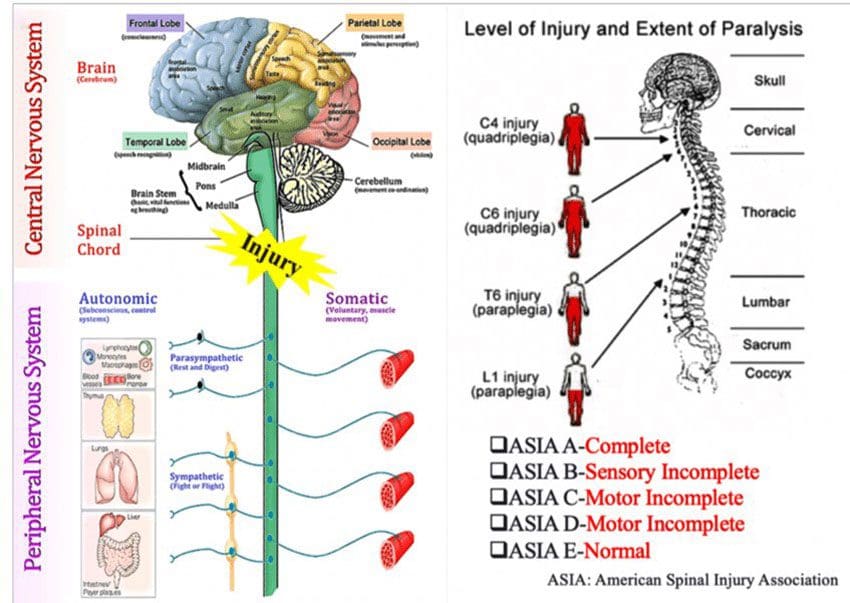
Table of Contents
Non-traumatic Spinal Cord Injury
Non-traumatic spinal cord injuries is an umbrella term that includes several disorders, like:
- Degenerative cervical myelopathy
- Degenerative spondylosis
- Rheumatoid arthritis
- Paget’s disease
- Multiple sclerosis
- Metastatic cancer
- Developmental disorders like Spina Bifida and cerebral palsy
- Transverse myelitis
- Amyotrophic lateral sclerosis or Lou Gehrig’s disease
- Friedreich’s ataxia
Understanding these disorders helps determine a correct diagnosis. Degenerative cervical myelopathy or DCM is the most common form of a non-traumatic spinal cord injury. It is a slow progressive injury that causes continued compression usually brought on by spondylosis or osteoarthritis of the spine’s joints. DCM can have a devastating effect on the quality of life if not diagnosed and treated as it can have a ripple effect by raising the risk of falls, leading to a traumatic spinal cord injury. Being aware can help in preventing the damage.
Other Causes and Complications
Other causes for non-traumatic spinal cord injury include:
- Nerve damage
- Blood supply loss to the spinal cord
- Compression from a tumor or blood clot
- Infection
- Spinal abscess
- Atherosclerosis
One of the most significant risk factors is age. This is due to an increased risk of conditions like osteoarthritis and hypertension as individuals get older, which is why individuals with a non-traumatic spinal cord injury are, on average, older than individuals that suffer a traumatic spinal cord injury. Weakness, instability, and loss of muscle control are common complications that can develop as the non-traumatic spinal cord injury progresses. Other complications that can present include:
- Chronic pain
- Sleep disturbance
- Constipation
- Urinary incontinence
- Urinary tract infections
- Impotence
- Pressure ulcers/bed sores if immobilized
- Possible blood clots that can lead to deep vein thrombosis
- Depression and anxiety
Treatment
With a traumatic spinal cord injury, treatment depends on the severity of the injury. With non-traumatic spinal cord injuries, treatment depends on what type of condition is involved. The primary treatment for non-traumatic spinal cord injuries typically involves various forms of rehabilitation to minimize further damage to the spinal cord. Surgery may be necessary if the spine needs to be decompressed.
Body Composition
Extracellular Water and Intracellular Water
Extracellular Water – ECW
- Extracellular is the water located outside the body’s cells.
- The water in the blood falls into this category.
- Around 1/3 of the body’s fluid is attributed to ECW, and this water is found in the interstitial fluid, transcellular fluid, and blood plasma.
- This water is important because:
- It helps control the movement of electrolytes.
- Allows oxygen delivery to the cells.
- Clears waste from metabolic processes.
Intracellular Water – ICW
- Intracellular is the water located inside the body’s cells.
- It comprises 70% of the cytosol, which is a mix of water and other dissolved elements.
- It makes up the other 2/3 of the water inside the body.
- Intracellular water is important because:
- It helps in cellular processes.
- Allows molecules to be transported to the different organelles inside the cell.
- Picks up where the extracellular water leaves off by continuing the pathway for fuel/energy to be transported to the cells.
References
Badhiwala, Jetan H et al. “Degenerative cervical myelopathy – update and future directions.†Nature reviews. Neurology vol. 16,2 (2020): 108-124. doi:10.1038/s41582-019-0303-0
Handbook of Clinical Neurology (2012) “Spinal Cord Injury.” www.sciencedirect.com/topics/medicine-and-dentistry/non-traumatic-spinal-cord-injury
Milligan, James et al. “Degenerative cervical myelopathy: Diagnosis and management in primary care.†Canadian family physician Medecin de famille canadien vol. 65,9 (2019): 619-624.
Physical Management in Neurological Rehabilitation (2004) “Spinal cord injury.” www.sciencedirect.com/topics/medicine-and-dentistry/non-traumatic-spinal-cord-injury
What's your reaction?