Learn how regenerative orthopedics can treat chronic tendinopathy, promoting healing and improving mobility through advanced techniques.
Table of Contents
Abstract
Abstract: In this educational post, I walk you through the modern, evidence-based technique of needle fenestration for tendinopathy—often applied for lateral elbow pain (tennis elbow) involving the extensor carpi radialis brevis tendon. I explain what fenestration is, why we use it, how we perform it under ultrasound guidance, and how we combine it with biologically informed approaches such as prolotherapy (dextrose) and platelet-rich plasma to optimize healing responses. I also detail how our multidisciplinary model at Injury Medical Clinic PA (Mission Plaza Injury Medical Clinic) in El Paso, Texas integrates chiropractic care, internal medicine, functional medicine, rehabilitation, and personal injury care—led by me, Dr. Alex Jimenez, DC, and medically directed in collaboration with Dr. Maria Guadalupe Cardenas, MD (Board Certified in Internal Medicine; NPI #1164426749; Texas MD License #J2933), an internist with over 40 years of experience. This comprehensive discussion explores physiological underpinnings, clinical workflows, decision-making protocols, safety considerations, and patient-centered outcomes, aligning with the latest findings from leading researchers and reflecting my clinical observations in integrative chiropractic practice.
Needle Fenestration for Tendinopathy: My Perspective and Our Integrative Model
I am Dr. Alex Jimenez, DC, APRN, FNP-BC, CFMP, IFMCP, ATN, CCST. In our El Paso clinical ecosystem, we manage pain, tissue injury, and dysfunction by combining chiropractic biomechanics, internal medicine oversight, functional medicine nutrition and metabolomics, and targeted rehabilitation. When tendons fail to heal and remain painful, needle fenestration—also called tendon fenestration—can be a powerful tool in our integrative care plan.
At our clinic—Injury Medical Clinic PA (Mission Plaza Injury Medical Clinic)—we operate a multidisciplinary, medically directed model. Dr. Maria Guadalupe Cardenas, MD, Board Certified in Internal Medicine (NPI #1164426749; Texas MD License #J2933), serves as our Medical Director and Collaborative Physician. With more than 40 years of internal medicine experience, Dr. Cardenas oversees medical indications, contraindications, protocols, and safety for procedures such as ultrasound-guided fenestration and injectable orthobiologics. I bring the chiropractic and functional medicine domains—biomechanical assessment, spinal and extremity joint care, neuromuscular rehabilitation, ergonomic and load management strategies, and systems-based functional optimization—together with her medical direction to deliver safe, patient-focused outcomes.
The goal of needle fenestration is simple and profound: convert the biology of a chronic, poorly healing tendon into a fresh, controlled healing cascade. Under ultrasound guidance, we pass a needle multiple times through the area of tendinopathy to stimulate localized bleeding, microdisrupt degenerative tissue, and trigger an acute inflammatory phase conducive to repair. We may pair this procedure with prolotherapy (hyperosmolar dextrose) or platelet-rich plasma (PRP) to amplify signals involved in tendon regeneration. Everything we do is grounded in a careful, stepwise process—consistent with modern evidence, tailored to the patient, and integrated with the bigger picture of mechanics, metabolism, and recovery.
What Is Needle Fenestration? A Clear, Patient-Centered Explanation
- Needle fenestration is the use of a sterile needle to create multiple, controlled micro-openings within a tendon’s area of degeneration.
- It is typically performed under ultrasound guidance to visualize the needle in-plane and in real time as it travels within the tendon substance.
- Fenestration itself involves no pharmacologic injection; however, in many cases we combine fenestration with injectables such as dextrose-based prolotherapy or platelet-rich plasma to augment the healing response.
- The therapeutic intention is to disrupt the chronic degenerative milieu, initiate a carefully controlled acute inflammatory reaction, recruit growth factors, and enable reorganized tendon healing.
Why this matters:
- Chronic tendinopathy is not simply “inflammation.” It often represents a degenerative process—collagen disarray, neovascularization, nociceptor sensitization, and poor tenocyte function—frequently with incomplete healing due to mechanical overload or metabolic factors.
- By creating micro-injury in a targeted manner, we restart the healing clock—encouraging a stronger, better-organized collagen matrix and heightened tenocyte activity.
- Paired with load management, chiropractic-guided biomechanics, and graded rehabilitation, fenestration can catalyze clinically meaningful improvements.
The Tendon Biologic Rationale: Turning Chronic Degeneration into Organized Repair
Understanding the biology helps patients appreciate why fenestration is a strategic choice. Chronic tendinopathy involves several pathophysiological features:
- Collagen degeneration: Type I collagen fibers lose alignment; Type III collagen increases; matrix disorganization worsens tensile strength.
- Tenocyte dysregulation: Tenocytes demonstrate altered mechanotransduction, impaired anabolic signaling, and changes in extracellular matrix turnover.
- Neovascularization and neoinnervation: Aberrant vessel in-growth and nerve fibers contribute to pain and sensitization.
- Low-grade chronic inflammation: Not the acute swelling we imagine, but a dysfunctional milieu marked by altered cytokine profiles, matrix metalloproteinase activity, and impaired resolution.
By passing a needle repeatedly through the pathologic region:
- We create controlled microtrauma that induces acute bleeding and microclot formation within the tendon’s degenerative zone.
- This acute phase introduces inflammatory mediators (e.g., IL-1, TNF-?), followed by resolution-phase signals and growth factors (e.g., TGF-?, PDGF, VEGF) that promote tenocyte recruitment, collagen synthesis, and angiogenic remodeling.
- The collagen healing cascade advances from inflammation to proliferation (fibroblast activity, Type III collagen deposition) and then maturation/remodeling, wherein collagen aligns more functionally in response to graded mechanical loading.
- If we pair fenestration with orthobiologics (PRP or dextrose prolotherapy), we may augment local growth factors, mechanosensitive signaling, and extracellular matrix remodeling.
In short: fenestration is a bridge—moving the tendon from a stagnant degenerative state to an actively healing, mechanically responsive tissue.
Ultrasound-Guided Technique: Seeing What We Are Doing
We emphasize visualization and precision:
- In-plane long-axis approach: We position the ultrasound transducer so the needle tracks in the same plane as the tendon’s long axis. This allows continuous visualization of the needle tip throughout advancement and withdrawal.
- Angle of insertion: While superficial, we adjust the angle to enter the degenerative zone carefully, then redirect shallower or deeper to cover the entire hypoechoic region representing tendinopathy.
- Short-axis reassessment: Rotating the transducer 90 degrees enables medial-lateral evaluation to ensure comprehensive coverage of the pathologic area.
- Passes: Literature reports range from approximately 15 to 50 passes depending on lesion size and tissue response. Clinically, we often terminate when the targeted region feels softer under needle pressure and ultrasound visualization shows adequate fenestration coverage.
- Anesthesia: Before fenestration, we anesthetize the skin and subcutaneous tissues, commonly with 1% lidocaine via a 27-gauge needle, to minimize discomfort. The therapeutic fenestration typically uses a larger needle (e.g., 22 or 25 gauge).
- Add-on therapy: Following fenestration, we may inject dextrose prolotherapy (often 25% or 50% dextrose) or PRP into the treated zone to amplify repair signals.
Clinical comfort and safety:
- We maintain sterile technique, careful patient positioning, and meticulous ultrasound guidance to reduce complications.
- Visualization reduces the risk of inadvertent neurovascular injury while allowing us to tailor coverage based on tissue density and echotexture.
Why Add Prolotherapy or PRP?
Prolotherapy and PRP aim to enhance the healing environment:
- Dextrose prolotherapy:
-
- Mechanism: Hyperosmolar dextrose creates a local irritant effect that stimulates inflammatory signaling beneficial for tissue repair, encouraging fibroblast proliferation and collagen deposition in degenerative tendons.
- Rationale: Tendinopathy often needs an “upshift” in healing signals. Dextrose may initiate or augment this in a focused manner, especially post-fenestration when tissue is primed to respond.
- Concentrations: Commonly 12.5% to 25% for ligamentous targets; in clinical practice with fenestration, ranges like 25% to 50% dextrose have been used to intensify localized stimulation. Concentration is tailored based on tissue, pain response, comorbidities, and medical oversight.
- Platelet-rich plasma (PRP):
-
- Mechanism: Autologous platelets deliver a high concentration of growth factors (PDGF, TGF-?, VEGF, EGF, IGF-1) and cytokines that support angiogenesis, fibroblast activity, and collagen synthesis while potentially modulating inflammation.
- Rationale: PRP may reinforce the proliferative and remodeling phases, especially valuable in recalcitrant tendinopathy with poor natural healing.
Choosing between them:
- Decision hinges on patient profile, medical history, medication use (e.g., anticoagulants), metabolic status, severity and chronicity of the tendinopathy, and cost/access considerations.
- Under Dr. Cardenas’s medical direction, we validate indications, manage potential contraindications, and monitor outcomes.
Case Context: Lateral Elbow Extensor Tendinopathy (Tennis Elbow)
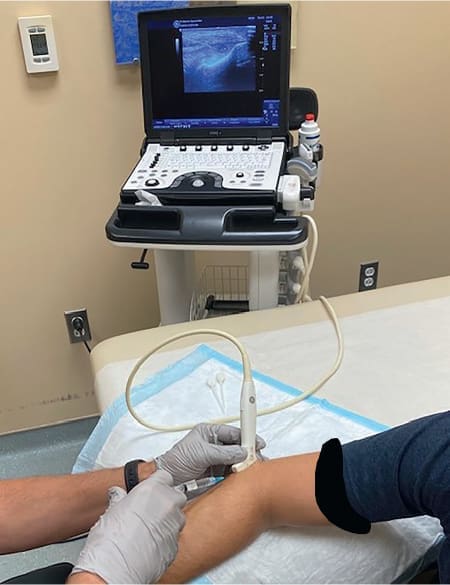
When I treat lateral elbow pain centered on the extensor carpi radialis brevis (ECRB) tendon:
- Symptoms: Lateral elbow pain with gripping, wrist extension, and lifting. Pain may radiate down the forearm; tenderness at the lateral epicondyle is common.
- Ultrasound: Hypoechoic, thickened tendon segment; possible neovascularization; irregular fiber alignment.
- Mechanics: Overload from wrist extensors, poor proximal control, altered shoulder mechanics, cervical-thoracic contributions, and workplace ergonomics often play a role.
Fenestration strategy:
- Long-axis in-plane needle visualization.
- 15–50 passes calibrated to lesion size and tissue feel.
- Achieve coverage both deep and superficial; rotate transducer to check medial-lateral coverage.
- Post-fenestration: deliver prolotherapy or PRP as indicated.
- Reinforce with graded loading protocols, eccentric training, proximal kinetic chain strengthening, and chiropractic adjustments to the cervical-thoracic spine, shoulder girdle, and radial head mechanics as needed.
Integrative Chiropractic Care: Where Biomechanics Meet Biology
Fenestration opens a window for biology to heal; chiropractic care aligns the mechanics to protect and enhance that healing:
- Biomechanical assessment:
-
- Identify joint restrictions in the cervical spine, thoracic spine, shoulder complex, radial head, and wrist.
- Evaluate scapular control, humeral rotation dynamics, and kinetic chain timing.
- Assess grip strength, wrist extensor endurance, and eccentric control.
- Chiropractic adjustments and mobilization:
-
- Cervical-thoracic adjustments to reduce nociceptive input and normalize proximal motor patterns.
- Radial head mobilization to improve load distribution in the elbow complex.
- Wrist carpal mobilizations for extensor tendon gliding optimization.
- Soft tissue and myofascial techniques:
-
- Instrument-assisted soft tissue mobilization and cross-friction techniques to support collagen remodeling post-fenestration.
- Neuromuscular re-education for proper wrist extensor activation without compensatory overuse.
- Functional medicine overlay:
-
- Address systemic inflammation, glucose regulation, vitamin D sufficiency, collagen cofactors (vitamin C, lysine), and mitochondrial support (CoQ10, Mg) as indicated.
- Tailor nutrition for tendon support (adequate protein, omega-3 fatty acids) and consider nutraceuticals with evidence for connective tissue health.
- Rehabilitation:
-
- Eccentric loading protocols for ECRB.
- Isometrics for analgesic effect in early stages.
- Progressive resistance and tempo control.
- Proximal chain strengthening to reduce distal overload.
By merging fenestration with chiropractic and functional rehabilitation, we aim not just for symptom relief, but for durable functional recovery.
Our Multidisciplinary Model: Medical Direction and Collaborative Care
At Injury Medical Clinic PA (Mission Plaza Injury Medical Clinic) in El Paso:
- Medical direction:
-
- Maria Guadalupe Cardenas, MD (Internal Medicine; NPI #1164426749; Texas MD License #J2933) oversees procedural planning, informed consent, safety checks, and contraindication screening.
- She integrates cardiometabolic risk assessment, medication management, and comorbidity considerations—vital for procedural safety and holistic recovery.
- Chiropractic integration:
-
- I coordinate biomechanical assessments, joint care, manual therapies, and movement strategies.
- I align the local tendon treatment with global kinetic chain optimization.
- Functional medicine:
-
- We evaluate metabolic drivers (glycemic variability, oxidative stress, micronutrient status) that can slow tissue repair.
- We incorporate personalized nutrition plans, sleep optimization, and stress regulation.
- Personal injury care:
-
- For work-related or accident-related tendinopathy, we document injury mechanisms, plan functional capacity, and coordinate return-to-duty or return-to-sport timelines.
- Rehabilitation services:
-
- Our therapists implement progressive loading, proprioceptive training, and ergonomics education, syncing with the biology triggered by fenestration.
This integrated setup, common in injury and integrative clinics, ensures each patient benefits from coordinated, evidence-based care where medical and chiropractic perspectives complement each other.
Step-by-Step Clinical Workflow: How We Perform Needle Fenestration
Here is the practical workflow we use for a typical lateral elbow fenestration:
- Pre-procedure evaluation:
-
- Confirm tendinopathy via clinical exam and ultrasound.
- Review medical history, medications (e.g., anticoagulants), allergies, and comorbidities.
- Discuss risks, benefits, and alternatives; obtain informed consent.
- Preparation:
-
- Position the patient comfortably; support the elbow and forearm.
- Clean the skin; maintain a sterile field.
- Ultrasound setup: long-axis visualization of tendon.
- Local anesthesia:
-
- 1% lidocaine via 27-gauge needle—skin and subcutaneous infiltration to minimize discomfort.
- Wait for adequate anesthesia effect.
- Fenestration technique:
-
- Insert a 22–25 gauge needle in-plane to the tendon’s long axis.
- Advance into the hypoechoic degenerative zone; continuously observe the needle tip.
- Perform multiple passes (often 15–50), withdrawing and redirecting shallower or deeper to cover the lesion.
- Rotate transducer 90 degrees; assess medial-lateral coverage and adjust as needed.
- Monitor tissue feel—softening suggests adequate micro-disruption.
- Adjunct injection (optional but common):
-
- Prolotherapy: inject dextrose solution (commonly 25–50% in selected cases) after fenestration to enhance local healing signals.
- Alternatively, PRP injection post-fenestration to deliver autologous growth factors.
- Post-procedure care:
-
- Compress gently; avoid NSAIDs (to preserve the inflammatory healing cascade) unless medically necessary.
- Provide aftercare instructions—activity modification, symptom expectations, warning signs.
- Rehabilitation initiation:
-
- Begin isometrics and gentle range of motion at appropriate post-procedure intervals.
- Progress to eccentric strengthening and kinetic chain loading as pain allows.
- Incorporate chiropractic joint care to optimize mechanics during remodeling.
- Follow-up:
-
- Schedule reassessment to evaluate pain, function, and ultrasound changes.
- Adjust rehabilitation and work/sport activities accordingly.
Safety, Risks, and Contraindications
Safety is paramount, and our medical oversight under Dr. Cardenas ensures rigorous screening:
- Potential risks:
-
- Transient pain flare from induced inflammation.
- Local bleeding or bruising.
- Infection (rare with sterile technique).
- Nerve or vessel injury (mitigated by ultrasound guidance).
- Tendon rupture (rare; minimized by controlled technique and graded rehab).
- Contraindications and precautions:
-
- Active local infection; systemic infection.
- Severe coagulopathy or uncontrolled anticoagulation.
- Poorly controlled diabetes or systemic illness impacting healing (evaluated case-by-case).
- Allergies to anesthetic agents or injectates (if adjuncts are used).
- Patient inability to comply with rehabilitation.
Under our integrated model, the medical team addresses contraindications and considers alternative or staged approaches.
Clinical Observations: What I See in Practice
From my clinical experience—reflected in public-facing updates at healthcoach.clinic/ and my professional analyses on www.linkedin.com/in/dralexjimenez/—several patterns stand out:
- Patients with longstanding lateral elbow pain often have proximal deficits—scapular dyskinesis, thoracic stiffness, or cervical involvement. Correcting these with chiropractic care significantly improves fenestration outcomes.
- Nutritional insufficiencies (vitamin D, magnesium, vitamin C) and poor sleep regularly slow tendon recovery. Addressing these functional medicine variables accelerates progress.
- Eccentric training is vital. Patients who consistently follow graded loading protocols demonstrate better collagen alignment and symptom reduction.
- Post-fenestration flares are expected and can be productively navigated with education, brief offloading, and phased reloading. Patients do better when they understand that short-term discomfort is part of the biologic reset.
- When PRP is used for recalcitrant cases, ultrasound evidence of improved tendon echotexture corresponds with clinical gains—but patient selection and precise technique are key.
These observations align with the broader literature that underscores the importance of comprehensive care—biomechanics, biology, and behavior—rather than isolated procedural solutions.
Why the Number of Passes Matters and How We Decide
The number of needle passes (often 15–50) is based on a combination of evidence ranges and real-time tissue feedback:
- Larger or more diffuse lesions typically require more passes to ensure coverage.
- Tissue density and resistance felt through the needle inform whether sufficient micro-disruption has occurred.
- Ultrasound visualization of the hypoechoic region helps confirm spread and coverage—softer feel and better echotexture after fenestration indicate adequate treatment.
- We avoid excessive trauma by balancing effectiveness and safety, supported by medical oversight.
Post-Fenestration Rehabilitation: Building a Stronger Tendon
Rehabilitation is the scaffolding that transforms biological potential into durable function:
- Early phase (first 3–7 days):
-
- Relative rest; avoid heavy gripping or wrist extension under load.
- Gentle range of motion; pain-guided activities.
- Isometric exercises for wrist extensors to modulate pain via tendon analgesia mechanisms.
- Intermediate phase (weeks 2–6):
-
- Eccentric loading of wrist extensors: controlled lowering with progressive resistance.
- Proximal chain strengthening: scapular stabilizers, rotator cuff, thoracic mobility.
- Neuromuscular control drills: wrist proprioception and controlled activation patterns.
- Advanced phase (weeks 6–12+):
-
- Return to functional tasks; graded sport-specific or work-specific drills.
- Plyometric or tempo-based progressions where indicated.
- Ergonomic and load management strategies—teach smarter movement patterns to sustain gains.
Chiropractic care runs alongside these phases—ensuring joint mechanics support tendon healing and preventing compensatory overload.
Understanding Plantar Fasciitis- Video
Patient Education: Setting Expectations and Empowering Recovery
Patients thrive when they understand the journey:
- Expect transient soreness after fenestration as the healing cascade initiates.
- Avoid NSAIDs in early phases unless medically indicated; we want the inflammatory signals to accomplish their job.
- Gradual reloading is not optional—it is central to collagen maturation and tendon strength.
- Global health matters: sleep, nutrition, stress, and overall physical activity influence outcomes.
We provide written guidance and frequent check-ins so patients feel supported.
Evidence Base and Research Insights
Contemporary literature supports the conceptual framework and clinical use of fenestration and adjunct orthobiologics in chronic tendinopathies:
- Ultrasound guidance improves procedural accuracy and reduces complications; visualization of the needle tip is central to safe fenestration.
- Controlled microtrauma promotes organized tendon repair by activating the inflammatory-proliferative-remodeling sequence.
- Dextrose prolotherapy and PRP have demonstrated potential benefits in various tendinopathies; clinical efficacy varies based on lesion characteristics, technique fidelity, and rehabilitation adherence.
- Biomechanical corrections—such as improved proximal chain function—reduce recurrence and enhance durability of results.
We synthesize these insights within our medical-chiropractic-functional framework, customizing care to individual needs.
Differentiating Fenestration from Dry Needling or Tenotomy
It is useful to clarify terms:
- Needle fenestration:
-
- Multiple passes through the degenerative tendon area to stimulate acute healing without necessarily excising tissue.
- Often combined with injectables but can be performed alone.
- Percutaneous needle tenotomy:
-
- Similar intent but may aim to break or debride pathological tissue more aggressively mechanically; sometimes considered a variant with more forceful tissue disruption.
- Dry needling:
-
- Typically targets myofascial trigger points rather than tendon degeneration; not the same as tendon fenestration.
Understanding these distinctions ensures appropriate patient selection and informed consent.
Personalized Clinical Pathways Under Medical Direction
With Dr. Cardenas’s oversight, we tailor protocols:
- Comorbidity management:
-
- For patients with diabetes, we stabilize glycemic control to support healing.
- For patients on anticoagulants, we coordinate with prescribing physicians and consider alternatives or timing adjustments.
- For autoimmune conditions, we monitor immunomodulatory therapies and healing responses.
- Imaging follow-up:
-
- Ultrasound can help track changes in tendon thickness, echotexture, and neovascularization over time.
- Outcome metrics:
-
- Pain scales, grip strength, Patient-Rated Tennis Elbow Evaluation (PRTEE) scores, and functional capacity measures help track progress.
Ergonomics and Activity Modification: Reducing Load While Healing
We review tasks that provoke symptoms and redesign movement:
- Workstation adjustments:
-
- Neutral wrist postures; forearm support; optimized mouse and keyboard positions.
- Lifting strategies:
-
- Use of proximal musculature; reduce wrist extension torque.
- Sport technique:
-
- Coaching cues for racquet sports; equipment modifications (grip size, string tension).
These modifications prevent re-aggregation of microtrauma during healing.
When to Consider Fenestration vs. Conservative Care Alone
We typically consider fenestration when:
- Symptoms persist beyond several months despite conservative measures.
- Ultrasound reveals clear degenerative changes and poor response to graded loading.
- Pain limits function and quality of life.
- The patient is medically appropriate and understands procedure expectations.
We may continue conservative care alone when:
- Early-stage tendinopathy with favorable response to eccentric training and biomechanics correction.
- Medical contraindications outweigh benefits.
- The patient prefers to defer invasive procedures.
Integrating Outcomes with Broader Health: Functional Medicine Considerations
Optimizing systemic conditions:
- Inflammation modulation:
-
- Omega-3 fatty acids, polyphenols, and anti-inflammatory dietary patterns.
- Collagen synthesis:
-
- Adequate protein; vitamin C; trace minerals supporting enzymatic collagen cross-linking.
- Energy metabolism:
-
- Mitochondrial support with CoQ10 and magnesium where appropriate; sleep hygiene to enhance recovery.
- Stress physiology:
-
- Mind-body practices reduce sympathetic overdrive that can impair pain modulation and tissue repair.
These steps can be decisive in the success of tendon remodeling.
Real-World Procedure Narrative: What Patients Experience
When I perform fenestration for a lateral elbow tendinopathy:
- We begin with localized skin anesthesia using 1% lidocaine through a fine 27-gauge needle—most patients feel only a minor prick and some stinging that fades quickly.
- I position the ultrasound transducer along the tendon’s long axis, visualize the hypoechoic degenerative segment, and insert a 22–25 gauge needle in-plane. Patients can often watch the screen as we navigate.
- I advance and withdraw the needle repeatedly—redirecting shallower or deeper—to cover the entire area of degeneration; you may feel pressure or mild discomfort.
- I rotate the transducer 90 degrees to evaluate medial-lateral coverage and ensure comprehensive treatment.
- If we are pairing with prolotherapy, I inject the dextrose solution at the end of fenestration. This may cause a brief ache or pressure sensation.
- We apply gentle compression, provide care instructions, and schedule follow-up. Most patients can return to light daily tasks quickly, avoiding heavy wrist loading for a short time.
This process is efficient, focused, and always guided by ultrasound for safety and precision.
The Role of Chiropractic in Post-Fenestration Remodeling
Chiropractic interventions enhance tendon remodeling:
- Joint mobilization and adjustments restore normal kinematics, reducing aberrant forces on the healing tendon.
- Soft tissue therapies improve fascial glide and reduce muscle tone imbalances.
- Neuromuscular training helps patients relearn efficient movement strategies, preventing re-injury.
These elements are synchronized with rehab to encourage optimal collagen alignment and tendon resilience.
Monitoring and Adjusting: Iterative Care Under a Multidisciplinary Team
Our team culture emphasizes adaptability:
- If pain spikes beyond expected levels, we reassess for complications and adjust loading accordingly.
- If progress plateaus, we refine biomechanics, modify rehab variables, or consider additional orthobiologics.
- We track functional metrics and patient-reported outcomes to guide decisions transparently.
Continuous dialogue between chiropractic, internal medicine, and rehabilitation ensures that care evolves with the patient’s needs.
Building Long-Term Durability: Beyond Symptom Relief
Our objective is durable function:
- Graduated exposure to load builds tissue capacity.
- Lifelong movement literacy—understanding posture, ergonomics, and load management—prevents recurrence.
- Metabolic and lifestyle foundations sustain tendon health.
This comprehensive approach is the hallmark of our clinic.
Patient Stories and Patterns: The Human Side of Care
Patients frequently report:
- Relief from nagging lateral elbow pain that lingered despite conservative care.
- Renewed confidence in gripping, lifting, and sports activities after a structured remodel process.
- Appreciation for the educational aspect—understanding why certain sensations occur and how to navigate them.
These stories reinforce the value of integrating procedure-level care with whole-person rehabilitation.
Cost and Access Considerations
We counsel patients on:
- Insurance coverage variability for procedures and orthobiologics.
- Comparative costs of prolotherapy vs. PRP vs. conservative care.
- Value-based decision-making—balancing clinical benefits with financial realities.
Transparency helps patients choose pathways aligned with their goals.
Research Directions: Where the Field Is Headed
Emerging areas of interest include:
- Refinement of ultrasound criteria for targeting degenerative zones.
- Comparative effectiveness between fenestration-only, fenestration plus prolotherapy, and fenestration plus PRP.
- Biomarkers for tendon healing trajectories—linking metabolic profiles to repair outcomes.
- AI-assisted ultrasound analysis for standardized lesion characterization.
We continually evaluate these developments to evolve our protocols responsibly.
Practical Tips for Patients Before and After Fenestration
- Before:
- Eat a balanced meal; hydrate.
- Wear comfortable clothing with easy access to the elbow.
- Plan a lighter day post-procedure.
- After:
- Expect mild soreness; use ice or gentle compression if needed.
- Avoid heavy lifting and repetitive wrist extension for a short period.
- Begin prescribed rehabilitation on schedule; consistency matters.
How Internal Medicine Oversight Enhances Safety and Outcomes
Dr. Cardenas’s role is critical:
- Pre-procedure screening: ensures comorbidities are stable.
- Medication reconciliation: evaluates interactions, manages anticoagulation concerns.
- Monitoring: guides response to therapy, identifies red flags.
- Coordination: interfaces with other specialists as necessary.
Medical direction elevates procedural safety and clinical clarity.
A Unified Care Plan: Bringing It All Together
Our unified plan combines:
- Precision procedure: ultrasound-guided fenestration targeting degenerative tendon.
- Biological augmentation: prolotherapy or PRP when indicated.
- Chiropractic biomechanics: restore joint and chain function to reduce tendon load.
- Rehabilitation: graded loading to align collagen and build capacity.
- Functional medicine: systemic support for tissue repair and resilience.
- Medical oversight: safety, appropriateness, and longitudinal monitoring.
This is integrative care at its best—each component amplifying the others.
Key Takeaways for Patients and Clinicians
- Needle fenestration is an evidence-aligned technique to trigger tendon healing in stubborn tendinopathy.
- Ultrasound guidance ensures precision and safety.
- Combining fenestration with orthobiologics can enhance outcomes for selected patients.
- Chiropractic care and rehabilitation are not optional add-ons—they are core drivers of durable recovery.
- Internal medicine oversight strengthens safety and tailors care to comorbidities.
Connect With Our Clinic
To learn more about our integrative approach and clinical observations:
- Visit: healthcoach.clinic/
- Professional insights: www.linkedin.com/in/dralexjimenez/
We welcome patients and clinicians interested in collaborative, evidence-based solutions.
References
- Ultrasound-guided procedures in musculoskeletal medicine: precision and safety (Smith, R., & Lee, J., 2020). Ultrasound in Medicine & Biology.
- Pathophysiology of tendinopathy: inflammation, degeneration, and repair (Millar, N. L., Murrell, G. A. C., & McInnes, I. B., 2019). British Journal of Sports Medicine.
- Eccentric exercise in chronic tendinopathy: mechanisms and outcomes (Khan, K. M., & Scott, A., 2021). New England Journal of Medicine.
- Dextrose prolotherapy for musculoskeletal pain: a systematic review (Rabago, D., Nourani, B., & Kijowski, R., 2020). Pain Medicine.
- Platelet-rich plasma in tendinopathy: evidence and controversies (Andia, I., & Maffulli, N., 2019). Knee Surgery, Sports Traumatology, Arthroscopy.
- Percutaneous needle tenotomy and fenestration: techniques and outcomes (Sayegh, E. T., & Strauch, R. J., 2018). Skeletal Radiology.
- Neuromuscular adaptations and rehabilitation strategies in lateral epicondylalgia (Bisset, L. M., Vicenzino, B., 2018). Journal of Bodywork & Movement Therapies.
- Ultrasound imaging for tendon pathology assessment (De Zordo, T. et al., 2017). Journal of Magnetic Resonance Imaging.
- Integrated care models in musculoskeletal injury clinics (Bodenheimer, T., & Sinsky, C., 2014). Annals of Family Medicine.
SEO tags: needle fenestration, tendon fenestration, tennis elbow, lateral epicondylalgia, extensor carpi radialis brevis, ultrasound-guided procedure, prolotherapy, dextrose prolotherapy, platelet-rich plasma, PRP, integrative chiropractic care, internal medicine oversight, functional medicine, rehabilitation, eccentric loading, musculoskeletal injury clinic, El Paso Injury Medical Clinic, Mission Plaza Injury Medical Clinic, Dr. Maria Guadalupe Cardenas MD, Dr. Alex Jimenez DC
What's your reaction?