“Individuals who have suffered cervical acceleration-deceleration/CAD more commonly known as whiplash, can experience headaches, and other symptoms like neck stiffness, pain, fatigue, and shoulder/neck/back discomfort. Can non-surgical and conservative treatments help alleviate the symptoms?”
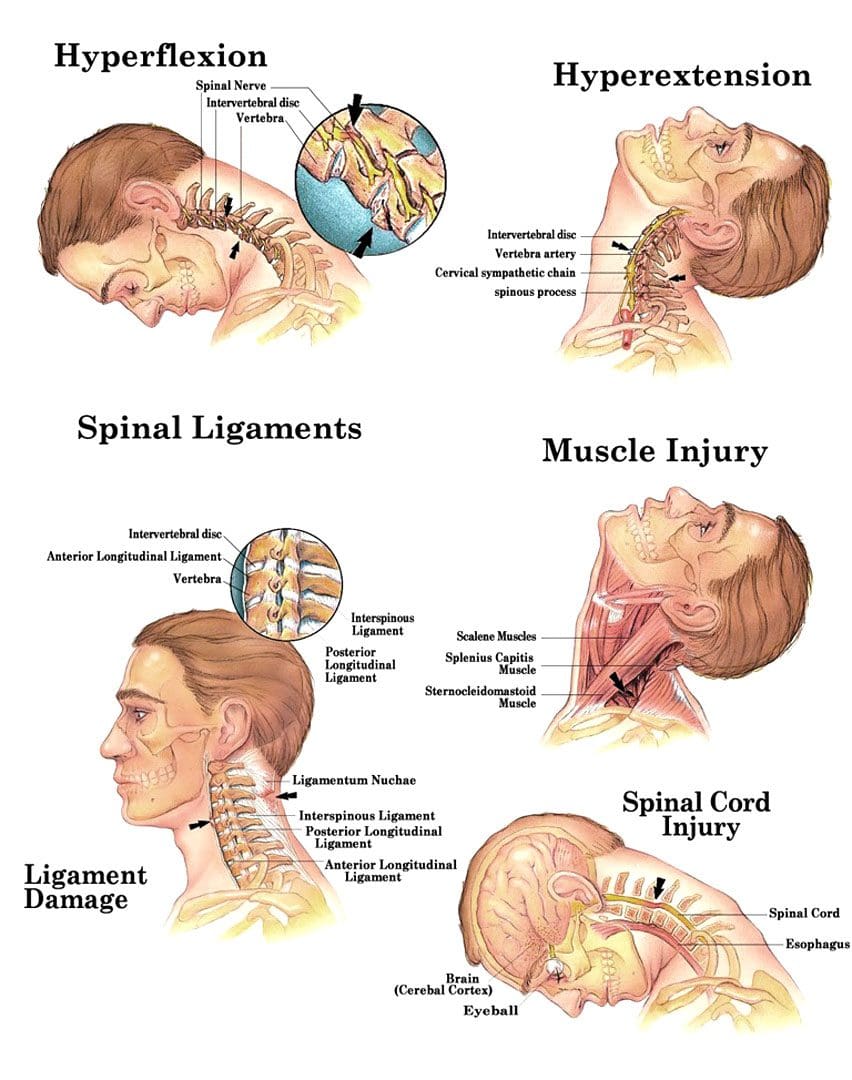
Table of Contents
Cervical Acceleration – Deceleration or CAD
Cervical acceleration-deceleration is the mechanism of a neck injury caused by a forceful back-and-forth neck motion. It happens most commonly in rear-end vehicle collisions when the head and neck whip forward and backward with intense acceleration and/or deceleration causing the neck to flex and/or extend rapidly, more than normally, straining and possibly tearing muscle tissues and nerves, ligaments, dislocation of spinal discs and herniations, and cervical bone fractures.
- For symptoms that do not improve or worsen after 2 to 3 weeks, see a healthcare provider or chiropractor for further evaluation and treatment.
- Whiplash injuries strain or sprain the neck muscles and/or ligaments, but can also affect the vertebrae/bones, disc cushions between the vertebrae, and/or the nerves.
- For individuals who experience a headache that starts at the base of the skull following a motor vehicle accident is more than likely a whiplash headache. (National Institute of Neurological Disorders and Stroke. 2023)
Symptoms
Whiplash symptoms can present right away, or after several hours to a few days after the incident, and tend to worsen in the days after the injury. Symptoms can last a few weeks to a few months, and can severely limit activity and range of motion. Symptoms can include: (National Institute of Neurological Disorders and Stroke. 2023)
- Pain that extends into the shoulders and back.
- Neck stiffness
- Limited neck motion
- Muscle spasms
- Numbness and tingling sensations – paresthesias or pins and needles in the fingers, hands, or arms.
- Sleep problems
- Fatigue
- Irritability
- Cognitive impairment – memory and/or concentrating difficulties.
- Ringing in the ears – tinnitus
- Dizziness
- Blurred vision
- Depression
- Headaches – A whiplash headache usually starts at the base of the skull and can vary in intensity. Most individuals experience pain on one side of the head and toward the back, though some can experience symptoms all over their head, and a small number experience headaches on the forehead or behind the eyes. (Monica Drottning. 2003)
- The headaches can become aggravated by moving the neck around, especially when looking up.
- Headaches are often associated with shoulder pain along with sensitive neck and shoulder muscles that when touched can increase pain levels.
- Whiplash headaches can lead to chronic neck-related headaches known as cervicogenic headaches. (Phil Page. 2011)
Causes
The most common cause of whiplash is rear-end automobile accidents and collisions. (National Institute of Neurological Disorders and Stroke. 2023)
However, cervical acceleration-deceleration injuries can also occur from:
- Playing sports – hockey, martial arts, boxing, tackle football, gymnastics, basketball, volleyball, soccer, and baseball.
- A slip and fall that causes the head to suddenly jolt forward and back.
- Physical assault – getting punched or shaken.
- Being struck on the head by a heavy or solid object.
Treatment
- Symptoms usually resolve within 2 to 3 weeks.
- Icing the neck for 10 minutes several times a day can help reduce pain and inflammation. (National Institute of Neurological Disorders and Stroke. 2023)
- It is also important to rest your neck area following the injury.
- A cervical collar can be utilized temporarily to stabilize the neck, but for long-term recovery, it is recommended to keep the area mobile.
- Physical activity reduction until the individual can look over both shoulders, and tilt their head all the way forward, all the way back, and from side to side without pain or stiffness.
Additional Treatments
- Traction and decompression therapies.
- Chiropractic adjustments
- Therapeutic various massage techniques.
- Electronic nerve stimulation
- Posture retraining
- Stretching
- Sleep position adjustments.
- Non-steroidal anti-inflammatories – NSAIDs – Ibuprofen or Naproxen.
- Muscle relaxers
If symptoms do not improve, a healthcare provider may recommend physical therapy and/or stronger pain medications. For whiplash headaches that last for several months, acupuncture, or spinal injections may be recommended.
Neck Injuries
References
National Institute of Neurological Disorders and Stroke. Whiplash Information Page.
Drottning M. (2003). Cervicogenic headache after a whiplash injury. Current pain and headache reports, 7(5), 384–386. doi.org/10.1007/s11916-003-0038-9
Page P. (2011). Cervicogenic headaches: an evidence-led approach to clinical management. International journal of sports physical therapy, 6(3), 254–266.
What's your reaction?