For individuals experiencing sacroiliac joint/SIJ dysfunction and pain, could applying kinesiology tape help bring relief and manage symptoms?

Table of Contents
Kinesiology Tape For Sacroiliac Joint Pain
A lower back ailment that is common during pregnancy. The pain is usually on one or both sides of the back, just above the buttocks, that comes and goes and can limit the ability to bend, sit, and perform various physical activities. (Moayad Al-Subahi et al., 2017) The therapeutic tape provides support while allowing for movement and may help treat and manage sacroiliac joint/SIJ pain by:
- Decreasing muscle spasms.
- Facilitating muscular function.
- Increasing blood circulation to and around the pain site.
- Decreasing muscle trigger points.
Mechanism
Some studies have found that taping the SI joint has benefits that include:
- Improved joint function
- Increased lumbar flexibility
- Reduced pain and disability. (Do-Yun Shin and Ju-Young Heo. 2017)
- One theory is it helps lift and hold the overlying tissues off of the SI joint, which helps decrease the pressure around it.
- Another theory is that lifting the tissues helps create a pressure differential under the tape, like non-surgical decompression, allowing increased circulation to the tissues surrounding the sacroiliac joint.
- This floods the area with blood and nutrients, creating an optimal healing environment.
Application
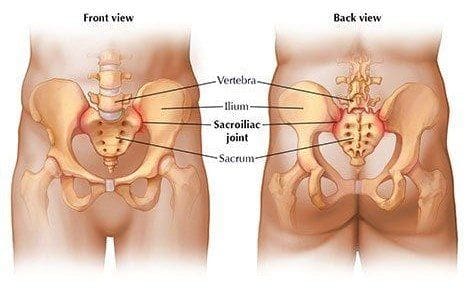
A sacroiliac joint on the right and left sides connects the pelvis to the sacrum or the lowest part of the spine. To apply the kinesiology tape correctly, locate the lowest part of the back within the pelvic area. (Francisco Selva et al., 2019) Ask a friend or family member for help if you can’t reach the area.
 Taping steps:
 Taping steps:
- Cut three strips of tape, each 4 to 6 inches long.
- Sit in a chair and bend the body slightly forward.
- If someone is helping, you can stand and slightly bend forward.
- Remove the lift-off strip in the middle and stretch the tape to expose several inches, leaving the ends covered.
- Apply the exposed tape at an angle over the SI joint, like making the first line of an X, just above the buttocks, with full stretch on the tape.
- Peel the lift-off strips from the ends and adhere them with no stretching.
- Repeat the application steps with a second strip, adhering at a 45-degree angle to the first strip, making the X over the sacroiliac joint.
- Repeat this with the final strip horizontally across the X made from the first two pieces.
- There should be a tape pattern of star shape over the sacroiliac joint.
- Kinesiology tape can stay over the sacroiliac joint for three to five days.
- Watch for signs of irritation around the tape.
- Remove the tape if the skin becomes irritated, and consult your primary healthcare provider, physical therapist, or chiropractor for other treatment options.
- Some individuals with specific conditions should avoid using the tape and get confirmation that it’s safe.
- Individuals with severe sacroiliac pain where self-management is not working should see a healthcare provider, physical therapist, and or chiropractor for an evaluation and to learn therapeutic exercises and treatments to help manage the condition.
Sciatica During Pregnancy
References
Al-Subahi, M., Alayat, M., Alshehri, M. A., Helal, O., Alhasan, H., Alalawi, A., Takrouni, A., & Alfaqeh, A. (2017). The effectiveness of physiotherapy interventions for sacroiliac joint dysfunction: a systematic review. Journal of physical therapy science, 29(9), 1689–1694. doi.org/10.1589/jpts.29.1689
Do-Yun Shin and Ju-Young Heo. (2017). The Effects of Kinesiotaping Applied onto Erector Spinae and Sacroiliac Joint on Lumbar Flexibility. The Journal of Korean Physical Therapy, 307-315. doi.org/https://doi.org/10.18857/jkpt.2017.29.6.307
Selva, F., Pardo, A., Aguado, X., Montava, I., Gil-Santos, L., & Barrios, C. (2019). A study of reproducibility of kinesiology tape applications: review, reliability and validity. BMC musculoskeletal disorders, 20(1), 153. doi.org/10.1186/s12891-019-2533-0
What's your reaction?